Your triceps make up roughly two-thirds of your upper arm, so if you want sleeves that actually fill out, they matter more than your biceps. Tricep dips are one of the best bodyweight ways to load them. They’re just not for everyone.
I stopped programming bench dips years ago because they parked my shoulders in a position my joints hated, and plenty of lifters feel the same. If you feel dips in the front of your shoulder or your elbow long before you feel them in your triceps, that’s your cue to swap.
Every job a dip does, another exercise covers too, usually with less joint stress and the option to add weight. Below are the eight tricep dip alternatives I actually reach for, whether I’m training at home with nothing but a floor or loading up heavy at the gym.
I picked these on four things: how hard they hit the triceps, how easy they are on the shoulders and elbows, what equipment they need, and whether you can progress them over time. Here’s the full list before we get into each one.
Table of Contents
- 1 The 8 Best Tricep Dip Alternatives
- 2 Reasons to Choose a Tricep Dip Alternative
- 3 Muscles Worked by Tricep Dips
- 4 Tricep Dip Alternatives: FAQs
- 5 Key Takeaways
- 6 Other Alternative Exercises
- 6.1 The 10 Best Overhead Press Alternatives
- 6.2 The 10 Best Plank Alternatives
- 6.3 The 8 Best Decline Bench Press Alternatives
- 6.4 The 10 Best Box Jump Alternatives
- 6.5 The 10 Best Pallof Press Alternatives
- 6.6 The 10 Best Glute Bridge Alternatives
- 6.7 The 10 Best Bench Press Alternatives
- 6.8 The 7 Best Deadlift Alternatives
- 6.9 The 10 Best Bent Over Row Alternatives
- 6.10 The 8 Best Hammer Curl Alternatives
- 6.11 The 9 Best Leg Press Alternatives
- 6.12 The 10 Best Romanian Deadlift Alternatives
- 6.13 The 10 Best Lying Leg Curl Alternatives
- 6.14 The 9 Best Barbell Row Alternatives
- 6.15 The 9 Best Seated Cable Row Alternatives (2026)
The 8 Best Tricep Dip Alternatives
- Narrow-Grip Push-Up
- Dumbbell Kickback
- Dumbbell Skull Crusher
- Overhead Cable Triceps Extension
- Close-Grip Bench Press
- Diamond Push-Up
- Neutral-Grip Dumbbell Press
- Cable Triceps Pushdown
1. Narrow-Grip Push-Up
When to Perform Narrow-Grip Push-Ups
This is my default when there’s no equipment around. A narrow-grip push-up follows almost the same pressing path as a dip but keeps your shoulder in a far friendlier spot, and you can do it anywhere. Bringing your hands just inside shoulder width shifts the work off your chest and onto your triceps. You’re also bracing your whole core the entire set, which is why I like it as an at-home way to keep building stronger, bigger triceps.
How to Perform Narrow-Grip Push-Ups
- Assume a high plank position with your core braced and your body forming one straight line.
- Flex your toes to engage the legs and glutes. Place your hands a few inches apart, just narrower than shoulder width.
- Keep your chin tucked and your gaze straight down between your hands. Actively grip the floor with your fingertips and rotate your upper arm bones outward to recruit your lats.
- Keep your torso braced and your spine neutral.
- Bend your elbows to lower your chest towards the floor. Keep your elbows tucked close to your body. They should travel directly behind your torso and not flare out.
- Pause when your upper arms are in line with your ribcage and your chest hovers an inch off the ground.
- Keeping your core engaged, press through your palms to lift your body back into a high plank position.
- Repeat for the desired number of sets and reps.
For a visual guide to doing narrow-grip push-ups, check out this video from Critical Bench.

Tips for Narrow-Grip Push-Ups
- Keep a straight line from head to heels. The second your hips sag, your abs have quit and your lower back takes over.
- Too hard? Put your hands on a bench or box. Too easy? Set a plate on your upper back or raise your feet.
- Keep your elbows tucked toward your ribs, not flared out to the sides, so the load stays on your triceps.
2. Dumbbell Kickback
When to Perform Dumbbell Kickbacks
When I want to load the triceps but keep things easy on the joints, the kickback is hard to beat. All you need is one dumbbell, and because you work one arm at a time, it’s the exercise I use to even out a weaker side. It hits the long head through elbow extension, and you can add a few pounds at a time to keep progressing.
How to Perform Dumbbell Kickbacks
- Hold a dumbbell in your right hand with a neutral grip (palm faces inward). Support your left knee and left hand on a flat bench for support. Plant your right foot firmly on the ground.
- Lean forward until your torso is parallel to the floor. Brace your core, tuck your chin, and gaze straight down.
- Lift the dumbbell so your elbow is tucked behind your torso and your wrist rests near your rib cage.
- Keep your shoulder locked in place, extend at the elbow, and allow the dumbbell to travel behind you.
- Extend your arm until it is straight but not locked out. Pause.
- Slowly lower the dumbbell back to its starting position. Repeat for the desired number of reps.
- Grab the dumbbell with your left hand and turn around so your right knee and right hand are planted on the bench. Repeat on the opposite side and complete an even number of sets per arm.
For a visual aid, check out this video from Scott Herman Fitness demonstrating the correct form for a dumbbell kickback.
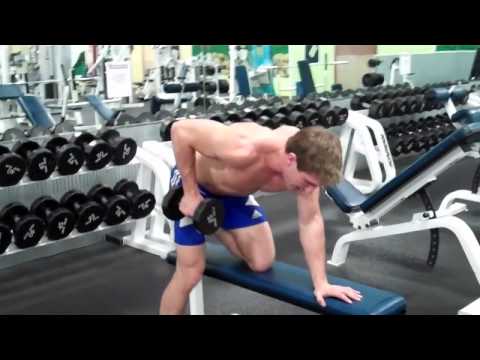
Tips for Dumbbell Kickbacks
- Lock your shoulder and torso in place. The only thing that moves is your forearm, and done right the exercise should isolate your triceps.
- No bench or dumbbell? Run kickbacks on a cable stack or with a resistance band for the same constant tension.
- Start with your weaker arm and match the reps on your stronger side.
3. Dumbbell Skull Crusher
When to Perform Dumbbell Skull Crushers
Skull crushers are my favorite way to isolate the triceps with real load. They train the same elbow extension as a dip without putting your shoulders anywhere near the compromised spot bench dips do, and a pair of dumbbells lets you add weight session to session. If you’re torn between these and overhead extensions, we sort that out in our tricep extension vs skull crusher comparison.
How to Perform Dumbbell Skull Crushers
- Lie flat on the ground or on a bench with your feet firmly planted on the floor. You can also tuck your feet under the foot pad of your bench if you have one.
- Hold a pair of dumbbells directly above your upper chest with a neutral grip (palms face each other).
- Grip the weight firmly to keep the wrists active for the entire set. Set your shoulders and engage your abdominals.
- Keep your elbows in a fixed position. Breathe in as you bend at the elbows and bring the weight slowly down towards your forehead.
- Hold for a second.
- Breathe out as you contract the triceps to straighten the arms and lift the weight back to its starting position.
- Repeat for the desired number of repetitions and set the weight down carefully.
For a visual guide to performing dumbbell skull crushers, here’s a useful video from Scott Herman Fitness.

Tips for Dumbbell Skull Crushers
- The eccentric is where the growth is. Lower the dumbbells toward your forehead as slowly as you can to pile up time under tension.
- Keep your elbows fixed in place so the triceps do all the work with no help from your shoulders.
- A barbell or EZ bar works just as well if you’d rather load both arms together.
4. Overhead Cable Triceps Extension
When to Perform Overhead Cable Triceps Extensions
Pressing overhead puts the long head on a deep stretch, and training a muscle in that stretched position is one of the best ways to grow it. I run these on a cable specifically because the cable holds tension on the triceps through the entire range instead of dropping off at the bottom the way a dumbbell does. It’s also easy on the elbows. Of all eight options, this is the one I’d add if your goal is a fuller-looking long head.
How to Perform Overhead Cable Triceps Extensions
- Attach the rope handle to the lowest point of the cable machine pulley.
- Stand with your back to the pulley and your feet firmly planted about hip-width apart.
- Reach behind to grab both sides of the rope handle with a neutral grip (palms facing inward).
- Bend your elbows so that your hands are holding the handle behind your head. Your forearms and biceps should be close to each other or touching.
- Keep your forearms still as you exhale and squeeze your triceps to straighten your arms. You should end up with your arms directly overhead with a neutral grip and a micro bend in the elbow.
- Slowly flex the elbows to bend the arms and lower the handle back to its starting position.
- Repeat for the desired number of reps and sets.
For a visual aid, here’s a useful video from Bodybuilding.com demonstrating the overhead cable triceps extension.

Tips for Overhead Cable Triceps Extensions
- Dumbbells, a kettlebell, or a barbell all work for overhead extensions, but only go overhead if your shoulders have the mobility for it.
- Lock your upper arms next to your ears and let only your forearms move.
5. Close-Grip Bench Press
When to Perform Close-Grip Bench Presses
This is the alternative for anyone who wants to load their triceps heavy. A close grip turns the bench press into a triceps lift, with a longer range of motion and more time under tension than a standard press. The carryover runs both ways: a stronger close-grip bench makes your dips and your regular bench better. If you’re weighing your pressing options, our dips vs bench press breakdown is worth a read.
How to Perform Close-Grip Bench Presses
- Place a loaded barbell into a rack set up over a bench.
- Lie down on the bench with your feet firmly planted on the ground and your back pressed into the bench. Your eyes should be directly in line with the barbell.
- Keep your glutes and core engaged, and tuck your chin to keep a neutral spine. Retract your shoulders slightly to avoid any rounding. Maintain this position throughout the exercise.
- Grip the bar with your hands about shoulder-width apart. This will vary based on your biomechanics; ensure your grip doesn’t cause your shoulders to rotate internally.
- Lift the bar out of the rack and position it straight over your shoulders with your arms tensed and elbows extended.
- Inhale and bend your elbows to lower the barbell to your lower chest or upper abdomen area. Tuck your elbows in closer than you would in a standard bench press.
- Exhale and push through your triceps to press the barbell back to its starting position with extended elbows.
- Repeat for the desired number of sets and reps.
This video from Scott Herman Fitness provides a helpful visual guide for performing the close-grip bench press.

Tips for Close-Grip Bench Presses
- Stack your wrists over your elbows and keep your elbows tucked. Flaring them is how close-grip benching ends up beating on your shoulders.
- Your chest and shoulders help less here than on a regular bench, so start lighter than you think and build up.
- Dial in your bench press form first if your regular press still feels shaky.
6. Diamond Push-Up
When to Perform Diamond Push-Ups
When a narrow-grip push-up stops being a challenge, the diamond push-up is the next step up. Bringing your hands together under your chest forces your elbows in tight and loads the triceps even harder, with a little extra work for the medial head that keeps your elbow stable. Still no equipment required.
How to Perform Diamond Push-Ups
- Get into position by holding a plank with your core braced and your body forming one straight line.
- Place your hands together directly under your chest so that your hands form a diamond or triangle shape.
- Squeeze your core and glutes for stability.
- Inhale and squeeze your triceps to lower your body towards the ground. Keep your elbows tucked close to your body to maintain tension on the triceps and protect the elbow and shoulder joint.
- Pause when your chest is almost touching the floor. Without flaring your elbows or arching your back, push through the triceps to raise your body back to its starting position.
- Repeat for the desired number of sets and reps.
Here’s a visual guide from Scott Herman Fitness to performing the diamond push-up.

Tips for Diamond Push-Ups
- Can’t do them off the floor yet? Do them with your hands on a bench and lower the angle as you get stronger.
- Too easy? Raise your feet or wear a loaded backpack.
- Keep your elbows brushing your sides on the way down, not winging out.
7. Neutral-Grip Dumbbell Press
When to Perform Neutral-Grip Dumbbell Presses
The neutral grip (palms facing each other) is the kindest pressing position for cranky shoulders, which is exactly why it earns a spot here. You still load the triceps and chest, but the shoulder sits in a position that tends not to complain. If dips or a standard bench press light up your shoulder or elbow, start here.
How to Perform Neutral-Grip Dumbbell Presses
- Lie on a flat bench with a dumbbell in each hand. Hold the dumbbells directly above your shoulders with a neutral grip (palms face towards your midline).
- Bend your elbows to lower the dumbbells towards your body. Keep your elbows tucked close to your torso throughout.
- Brace your core and engage your legs. Gaze straight ahead.
- Stop when the dumbbells are in line with your lower chest. Pause.
- Squeeze your triceps to press the dumbbells up above your shoulders.
- Repeat for the desired number of sets and reps.
This video from Wibbi provides a useful visual guide to the neutral-grip dumbbell press.

Tips for Neutral-Grip Dumbbell Presses
- Grip the dumbbells hard, like you’re trying to leave fingerprints. That keeps the small muscles around your wrist switched on and protects the joint.
- Keep your elbows tucked toward your ribs rather than flared out to shift more of the work onto your triceps.
8. Cable Triceps Pushdown
When to Perform Cable Triceps Pushdowns
The pushdown is the safest, most beginner-friendly option on this list, and it’s still one of the most effective. The low shoulder position means it won’t aggravate the joint the way dips and overhead work can, and triceps exercises with low shoulder elevation have been found to increase activation of the long head. It’s the one I’d hand a brand-new lifter first.
How to Perform Cable Triceps Pushdowns
- Stand facing a cable machine station and attach a straight bar, v-bar, or rope handle to a high pulley.
- If you are using a v bar or straight bar, grab the handle with a pronated grip. If using the rope handle, grab the rope near the butt end with your palms facing each other.
- Keep your chest up, retract your shoulder blades, and lean your torso forward slightly.
- Keep your elbows close to your torso throughout the movement. Press down with your triceps without bending your wrists until your arms are fully extended.
- Squeeze your triceps to lockout fully and hold for a moment.
- Slowly release to return the handle to its starting position.
- Repeat for the desired number of sets and reps.
Check out this video from Scott Herman Fitness for a visual guide on how to perform cable triceps pushdowns.

Tips for Cable Triceps Pushdowns
- No cable machine at home? A long loop band over a door anchor or pull-up bar does the same job for next to nothing.
- Keep your elbows pinned to your sides. If they drift forward, your chest and shoulders start stealing the work.
- For more angles, see our guide to the best tricep cable exercises.
Reasons to Choose a Tricep Dip Alternative
Dips are a great bodyweight builder, but they carry a real injury risk for some lifters, especially bench dips. Parking your hands behind you on a bench drags the shoulders into an internally rotated, extended position they didn’t sign up for, which is where the front-of-shoulder pain comes from. Swapping in weighted options also lets you keep adding load over time, which bodyweight dips can’t do once you’re strong. Rotating through a handful of different triceps exercises keeps your elbows happier and your training less monotonous. If your triceps lag in general, it’s worth mixing in some compound tricep exercises alongside these.
Muscles Worked by Tricep Dips
As the name suggests, tricep dips primarily target the triceps on the backs of your upper arms. They also recruit the traps, pecs, and shoulders to assist the movement.
- Primary muscles used: Triceps Brachii
- Secondary muscles used: Trapezius, Pectoralis Major, Pectoralis Minor, Deltoids (Anterior)
Tricep Dip Alternatives: FAQs
What’s the best tricep dip alternative at home?
If you’ve got no equipment, the narrow-grip push-up is the closest match to a dip, and the diamond push-up is the harder progression once that gets easy. Both need nothing but the floor. If you own a single dumbbell, add kickbacks or skull crushers so you can keep loading the triceps over time.
What’s the best dip alternative with dumbbells?
Dumbbell skull crushers load the triceps the heaviest of the dumbbell options and let you progress week to week. Kickbacks are the better pick if you want to even out a weaker arm or keep the load light on sore elbows. A neutral-grip dumbbell press is the one to use if your shoulders are the thing holding you back.
Do dips work your chest or your triceps?
Both, depending on how you set up. Dips done with wider hands and flared elbows lean on the pecs, while dips with tucked elbows and narrower hands put more of the work on the triceps.
Are dips safe for all lifters?
Not for everyone. Dips build real strength, but some lifters feel shoulder discomfort doing them, and bench dips in particular can cut your range of motion and load the deltoids in an unnatural position. If you want to hit your triceps without taxing your shoulders, pick exercises with low scapula elevation like cable pushdowns and dumbbell kickbacks. If you’d rather stay bodyweight, push-up variations are your best bet.
Can I do push-ups to replace dips?
Yes, especially if push-ups are more comfortable for your shoulders. They’re not identical and will work your muscles a little differently, so pick your variation carefully and use a full range of motion. To target your triceps, keep your hands closer together and tuck your elbows. To bias the pecs, widen your grip and let the elbows flare slightly.
Key Takeaways
Match the alternative to why you’re skipping dips in the first place. Training at home with no gear? Narrow-grip and diamond push-ups have you covered. Want to load your triceps heavy? Close-grip bench press and dumbbell skull crushers let you keep adding weight. Shoulders or elbows that flare up on dips? Cable pushdowns and neutral-grip dumbbell presses keep the joint out of trouble while still hammering the triceps. You don’t need all eight. Pick the two or three that fit your equipment and your joints, then rotate them.
Other Alternative Exercises
If you enjoyed this post, check out our other roundups of the best alternatives for other exercises.