The shrug is about as simple as strength training gets. Grip something heavy and pull your shoulders straight up toward your ears. That simple motion is one of the most direct ways to load your upper trapezius, the thick slab of muscle that runs from your neck out to your shoulders and gives your upper back that finished look from behind. It’s a small range of motion carrying heavy weight, and that combination is exactly what makes the muscle grow. Most lifters default to a barbell or dumbbells for it, but the traps respond to plenty of other tools too, cables, a trap bar, even nothing but a loaded carry.
You might want a swap for a few reasons. A heavy barbell shrug can beat up your wrists and forearms before your traps ever get properly worked, your grip might give out well before your traps do, or you might not have a barbell at home to begin with. Some lifters also want more out of the movement than a straight up-and-down shrug gives, more range of motion, more retraction, or a different angle to keep making progress once a plain shrug plateaus. And a few of the options below train your traps as a byproduct of a bigger, more useful exercise instead of as an isolated add-on at the end of your session.
I picked the 8 alternatives below for how directly they load your traps, how heavy you can safely take them, and what equipment they need, so you can find one that fits your gym or your garage. Keep reading for when to use each one, exactly how to perform it, and the cues that get you more out of every rep.
Table of Contents
- 1 The 8 Best Shrug Alternatives
- 2 Reasons to Choose a Shrug Alternative
- 3 Muscles Worked by the Shrug
- 4 FAQs
- 4.1 Can I build big traps without doing barbell shrugs?
- 4.2 What is the best shrug alternative for grip problems?
- 4.3 What is the best shrug alternative to do at home?
- 4.4 Do I need direct trap work if I already deadlift and row?
- 4.5 How often should I train my traps?
- 4.6 Do shrugs or shrug alternatives shorten your neck?
- 5 Key Takeaways
- 6 Other Alternative Exercises
- 6.1 The 9 Best Seated Cable Row Alternatives (2026)
- 6.2 The 8 Best Incline Bench Press Alternatives
- 6.3 The 10 Best Front Squat Alternatives
- 6.4 The 9 Best Lunge Alternatives
- 6.5 The 10 Best Glute Bridge Alternatives
- 6.6 The 10 Best Leg Extension Alternatives
- 6.7 The 7 Best Deadlift Alternatives
- 6.8 The 10 Best Lying Leg Curl Alternatives
- 6.9 The 10 Best Dumbbell Pullover Alternatives
- 6.10 The 10 Best Lat Pulldown Alternatives
- 6.11 The 9 Best T-Bar Row Alternatives
- 6.12 The 12 Best Pull-Up Alternatives
- 6.13 The 8 Best Ab Rollout Alternatives
- 6.14 The 8 Best Decline Bench Press Alternatives
- 6.15 The 8 Best Tricep Dip Alternatives
The 8 Best Shrug Alternatives
- Dumbbell Shrug
- Trap Bar Shrug
- Cable Shrug
- Farmers Carry
- Snatch-Grip Shrug
- Rack Pull
- Kirk Shrug
- Upright Row
1. Dumbbell Shrug
When to Perform Dumbbell Shrugs
This is the swap I reach for first when a lifter’s grip gives out on barbell shrugs before their traps ever get properly loaded. Dumbbells hang straight down at your sides instead of resting against your thighs, so you get a slightly longer range of motion than a barbell shrug allows. It’s also the easiest version to do at home with nothing but a pair of dumbbells, and each hand moves independently, so a stronger or weaker side can’t hide behind the other. Run it for 3 to 4 sets of 10 to 15 reps, and add weight once 15 clean reps starts to feel easy.
How to Perform Dumbbell Shrugs
- Hold a dumbbell in each hand at your sides, palms facing your body.
- Stand tall with your feet about shoulder-width apart and let your arms hang straight down.
- Shrug your shoulders straight up toward your ears without bending your elbows.
- Pause and squeeze at the top, then lower under control back to the start.
Equipment: a pair of dumbbells.
This video from Buff Dudes Workouts shows how to perform the dumbbell shrug.

Tips for Dumbbell Shrugs
- Keep your arms straight throughout, let your traps do the lifting instead of your biceps.
- Drive your shoulders straight up, not backward in a rolling motion.
- Pause for a full second at the top to get more out of every rep.
- Use dumbbells heavy enough that grip becomes a limiting factor by the last couple of reps, and reach for straps once that starts costing you reps you’d otherwise get.
2. Trap Bar Shrug
When to Perform Trap Bar Shrugs
I like this one when a lifter already has a trap bar loaded for deadlifts and wants a heavy trap finisher without switching equipment. The neutral, hip-level grip is far easier on your wrists and elbows than a straight barbell, so you can pile on weight without your joints complaining first. It’s the closest thing to a barbell shrug for pure loading capacity, and because the handles sit at your sides rather than in front of your thighs, the bar doesn’t bump against your legs the way a straight bar does on heavier sets. Keep the reps in the 6 to 10 range for 3 to 4 sets, this is a strength-and-size exercise, not a burnout set.
How to Perform Trap Bar Shrugs
- Load a trap bar and step inside the frame with your feet about hip-width apart.
- Bend down and grip the handles with a neutral grip, keeping your back flat.
- Stand up to lockout, then shrug your shoulders straight up toward your ears.
- Lower your shoulders back down, then either reset the bar on the floor between reps or hold lockout for multiple reps in a row.
Equipment: a trap bar (hex bar) and plates.
This video from Live Lean TV Daily Exercises shows how to perform the trap bar shrug.

Tips for Trap Bar Shrugs
- The neutral grip lets you load heavier than a straight bar without extra elbow or wrist stress.
- Keep the bar path tight against your body for the whole set.
- Reset your grip between heavy reps instead of letting the handles drift in your hands.
- If your gym only has one trap bar and it’s tied up for deadlifts, this is a good one to slot in right after your last deadlift set while the bar is already loaded.
3. Cable Shrug
When to Perform Cable Shrugs
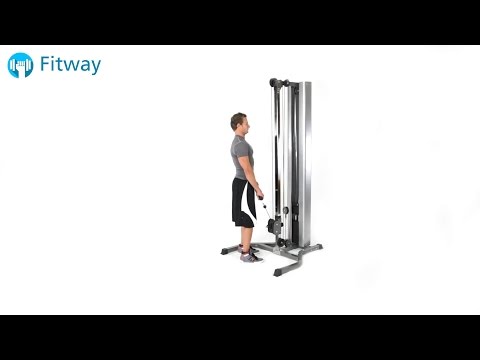
I put this one on the list for constant tension. A barbell or dumbbell shrug loses tension at the very top and bottom of the rep, but a cable keeps pulling on your traps through the entire range. It’s also easy on the joints, so it’s a good pick for higher-rep work or for anyone whose wrists or elbows need a break from free weights. Since the machine sets the bar path for you, it’s also a solid choice toward the end of a session when your grip and stabilizers are already fatigued. Run 12 to 20 reps for 3 sets to get the most out of the tension.
How to Perform Cable Shrugs
- Attach a straight bar to a low pulley on a cable machine.
- Stand facing the machine and grip the bar with a shoulder-width, overhand grip.
- Step back enough that the weight stack lifts off the pins, then stand tall.
- Shrug your shoulders straight up, squeeze at the top, then lower under control.
Equipment: a cable machine with a low pulley.
This video from Fitway shows how to perform the cable shrug.
Tips for Cable Shrugs
- Keep a slight bend in your knees and hips so the cable doesn’t pull you forward.
- Slow the lowering phase down, the cable makes the negative just as hard as the lift.
- Run this one at higher reps, 12 to 20, since it’s gentle on your joints.
- Swap the straight bar for a rope or two single handles if you want each shoulder working independently.
4. Farmers Carry
When to Perform the Farmers Carry
I consider this one of the most underrated trap builders around. Instead of a rep, your traps hold your shoulders up under a heavy, awkward load for time, which builds size and endurance at once. It also trains your grip, core, and posture along the way, and you don’t need a single piece of gym equipment to do it, a loaded backpack or a pair of full water jugs works in a pinch. See our full breakdown of the farmers carry benefits and muscles worked for more on why this one earns a spot in almost any program. Treat it as a finisher, 3 to 4 rounds of 30 to 40 seconds or 40 to 60 yards, resting a minute or two between rounds.
How to Perform the Farmers Carry
- Load two heavy dumbbells, kettlebells, or farmer’s handles and set them beside your feet.
- Bend down, grip them, and stand up tall by driving through your legs, not your back.
- Walk forward in controlled steps, keeping your shoulders back and chest up.
- Set the weights down under control once you hit your distance or time, then reset and repeat.
Equipment: a pair of heavy dumbbells, kettlebells, or farmer’s handles.
This video from SET FOR SET shows how to perform the farmer’s walk correctly.

Tips for the Farmers Carry
- Let your traps hold your shoulders up naturally, don’t shrug up and lock into a high position for the whole walk.
- Brace your core hard, walking with a loaded spine is where backs get hurt.
- Time or distance both work as a target, 30 to 40 seconds or 40 to 60 yards is a solid starting point.
- Go heavier than feels comfortable on the grip. This exercise rewards loads you can barely hold for the full distance, not weights you could carry all day.
5. Snatch-Grip Shrug
When to Perform Snatch-Grip Shrugs
This is the one I switch a lifter to once they’ve plateaued on a standard shrug and need more out of the exercise. The wide grip drops your starting position lower and adds a retraction component, so your shoulder blades pull together as well as up. It hits the traps from a genuinely different angle instead of just adding weight to the same old pattern, and because your hands start so far apart, the whole upper back has to work harder just to keep the bar under control. Stick to 8 to 12 reps for 3 sets, and don’t be surprised if you’re using 20 to 30 percent less weight than your standard shrug at first.
How to Perform Snatch-Grip Shrugs
- Set a barbell on the floor or in a rack and take a wide, snatch-width grip with your hands well outside your shoulders.
- Stand up holding the bar at arm’s length in front of your hips.
- Shrug your shoulders straight up and slightly back, driving your shoulder blades together at the top.
- Lower under control back to the starting position.
Equipment: a barbell (from the floor or a rack).
This video from Natural Hypertrophy shows how to perform the wide-grip, snatch-grip shrug.

Tips for Snatch-Grip Shrugs
- The wide grip is harder on your grip strength, use straps if your hands give out before your traps do.
- Let your shoulder blades come together at the top instead of just shrugging straight up.
- Start lighter than your normal shrug weight, the extra range makes this version harder than it looks.
- Pull the bar from just below the knee rather than the floor if your lower back or hamstrings are already worked from another exercise that day.
6. Rack Pull
When to Perform Rack Pulls
This is my pick when someone wants trap size without adding another isolation exercise to their day. The top portion of a deadlift, from the knee to lockout, is where your traps and upper back work hardest, and a rack pull lets you overload that exact range with heavier weight than you could ever pull from the floor. It builds pulling strength and trap thickness at the same time, and it’s a good option if a full deadlift beats up your lower back but you still want to train that top-end lockout hard. See our full rack pulls vs deadlifts comparison for how the two stack up. 3 to 5 reps for 3 to 4 sets is plenty, this is a strength exercise, not a pump exercise.
How to Perform Rack Pulls
- Set the pins or safeties in a rack just below or at knee height and load the bar.
- Stand with your feet hip-width apart and grip the bar just outside your legs.
- Brace your core, flatten your back, and drive through your legs to stand the bar up.
- Pull your shoulders back and finish tall, then lower the bar back to the pins under control.
Equipment: a squat rack or power rack with safety pins, and a barbell.
This video from PureGym shows how to perform the rack pull.

Tips for Rack Pulls
- Set the pin height to match what you’re training, lower for more range, just below the knee for the heaviest loads.
- Keep the bar dragging up your shins and thighs for the entire pull.
- Don’t lean back and hyperextend your lower back at the top, finish tall instead.
- Use straps once your grip is the reason a set ends rather than your back or traps, this exercise gets loaded heavy fast.
7. Kirk Shrug
When to Perform Kirk Shrugs
I save this one for lifters who’ve already built a base with the exercises above and want a finisher that hits their traps from a different line of pull. Holding the bar behind your body instead of in front changes the angle enough to feel like a completely different exercise, and plenty of lifters report a noticeably deeper contraction because the bar path pulls your shoulder blades back as well as up. It’s named for powerlifter Kirk Karwoski, who built some of the biggest traps the sport has seen using this exact variation. 2 to 3 sets of 10 to 15 reps at the end of a session is enough, this isn’t an exercise to max out on.
How to Perform Kirk Shrugs
- Stand holding a barbell behind your body at arm’s length, palms facing back.
- Stand tall with your feet about shoulder-width apart.
- Shrug your shoulders straight up and back.
- Lower under control back to the starting position.
Equipment: a barbell.
This video from OriGym shows how to perform the barbell shrug behind the back, also called the Kirk shrug.

Tips for Kirk Shrugs
- Use less weight than your regular shrug, the position is awkward the first few times you try it.
- Keep your arms straight and let the motion come from your shoulders, not your elbows.
- Save this one for the end of a session once your traps are already warm.
- Set the bar up in a rack behind you at about hip height so you’re not fumbling to get it into position from the floor.
8. Upright Row
When to Perform Upright Rows
This is the one I hand to someone who wants their traps and side delts working together instead of separately. Unlike a pure shrug, an upright row adds elbow flexion and shoulder abduction into the mix, so you’re building the meaty part of your upper back and shoulders at the same time. It’s a solid way to close out a shoulder or back day, and it doubles as a shoulder-width test of sorts, some lifters can pull it pain-free with a wide grip and dumbbells but feel it in the joint with a narrow barbell grip. 3 sets of 10 to 12 reps works well, and it pairs nicely as a superset with any shrug variation if traps are the priority that day.
How to Perform Upright Rows
- Hold a barbell or a pair of dumbbells in front of your thighs with an overhand grip about shoulder-width apart.
- Stand tall with your feet about shoulder-width apart.
- Pull the weight straight up along your body, leading with your elbows, until your elbows reach about shoulder height.
- Lower back down under control to the starting position.
Equipment: a barbell, dumbbells, or a cable with a straight bar attachment.
This video from Colossus Fitness shows how to perform the barbell upright row correctly.

Tips for Upright Rows
- Keep the bar or dumbbells close to your body throughout the pull.
- If your shoulders bother you, use a wider grip or switch to dumbbells, both take stress off the joint.
- Stop the pull at shoulder height, going higher shifts stress onto the front of the shoulder for little added benefit.
- Drop the weight below what you’d guess if this is new to you. Most lifters overestimate the load their shoulders can handle in this position.
Reasons to Choose a Shrug Alternative
There are a few good reasons to swap out a plain barbell or dumbbell shrug for one of the options above. None of these require you to give up shrugs entirely, most work well rotated in every few weeks alongside your usual version:
- You want more range of motion. The snatch-grip shrug and Kirk shrug travel further and add a retraction component that a standard shrug doesn’t.
- Your grip gives out before your traps do. The trap bar shrug and cable shrug let you load heavy without your hands failing first.
- You don’t have a barbell. Dumbbells, a cable stack, or a pair of kettlebells cover you completely.
- You want carryover to your other pulls. The rack pull and farmers carry build trap strength inside a bigger, more useful movement instead of as a standalone isolation exercise.
- You want more than just your traps. The upright row pulls your side delts in as well, so you get two muscle groups worked in one exercise.
- A plain shrug has stopped working. Once the weight on your bar stalls for a few weeks in a row, switching the angle, grip width, or implement is often enough to get the muscle responding again.
If your traps are lagging behind the rest of your upper back no matter which version you run, our guide to growing underdeveloped traps covers how to fix that specifically.
Muscles Worked by the Shrug
The shrug and its alternatives mainly train the muscles that control your shoulder blades:
- Upper trapezius: the main mover, pulls your shoulder blades straight up toward your ears.
- Levator scapulae: runs alongside the upper traps and assists with shoulder blade elevation.
- Middle and lower trapezius: stabilize your shoulder blades, especially on the wider-grip versions.
- Rhomboids: help retract your shoulder blades on variations like the snatch-grip shrug and Kirk shrug.
- Forearms and grip: heavily taxed on the farmers carry, rack pull, and snatch-grip shrug.
Well-developed traps also do real work outside the gym. They help stabilize your shoulder blades under any overhead or loaded carrying task, and they’re one of the first things people notice from behind, since the muscle sits right where a shirt collar hits. Your traps are only part of a well-developed upper back, though. For the rest, see our guides to middle trap exercises and lower trap exercises.
FAQs
Can I build big traps without doing barbell shrugs?
Yes. Your traps respond to being loaded through elevation with enough volume over time, and that load can come from a barbell, dumbbells, a cable stack, or even your own bodyweight against a loaded carry. Every alternative on this list will grow your traps if you take it close to failure and add weight or reps over time. What matters is consistent, progressive loading, not which specific tool you use to apply it.
What is the best shrug alternative for grip problems?
The trap bar shrug and cable shrug are the friendliest options, since neither forces you to death-grip a thin, straight bar the way a heavy barbell shrug does. Lifting straps also solve most grip issues if you’d rather stick with a barbell version, and they’re worth using on the rack pull and snatch-grip shrug too once your hands become the limiting factor instead of your traps.
What is the best shrug alternative to do at home?
The dumbbell shrug if you own a pair of dumbbells, and the farmers carry if you have anything heavy enough to walk with. A pair of jugs, kettlebells, or even loaded suitcases work. Between those two, you can train your traps hard without any gym equipment at all, and both scale up easily once you outgrow whatever weight you started with.
Do I need direct trap work if I already deadlift and row?
Probably, if trap size is actually a goal. Heavy deadlifts and rows load your traps isometrically, but rarely with enough volume on their own to grow them the way dedicated sets will. If your traps look like they’re lagging behind the rest of your upper back, add 2 to 3 sets of one of these alternatives a couple of times a week. Our guide to growing underdeveloped traps covers this in more detail.
How often should I train my traps?
Twice a week is plenty for most lifters, since your traps also get worked indirectly on deadlift, row, and overhead press days. Pick one or two alternatives from this list, run them for 2 to 3 sets of 8 to 15 reps, and give yourself at least 48 hours before hitting them directly again.
Do shrugs or shrug alternatives shorten your neck?
No. Bigger traps can make your neck look thicker or more built up, but that’s a change in the muscle around your neck, not the neck itself. If anything, strong traps and a strong upper back support better posture, which tends to make your neck and shoulders look more put together, not shorter.
Key Takeaways
If you already have a barbell, the trap bar shrug is the closest heavy-loading swap without a bar banging against your thighs. Training at home, the dumbbell shrug or a loaded farmers carry cover you completely. And if your grip fails before your traps do on every set, switch to the cable shrug so the machine holds the weight instead of your hands. Pick the alternative that fits your equipment and your joints, and progress it the same way you’d progress a barbell shrug. If your shoulders ever feel worse after a session instead of just worked, drop the upright row first, it’s the one most likely to bother the joint.
Other Alternative Exercises
If you enjoyed this post, check out our other roundups of the best alternatives for other exercises.