The sit-up is about as classic as ab exercises get. You lie on your back with your knees bent, anchor your feet somehow, and curl your whole torso up until your chest gets close to your knees. It trains your rectus abdominis through a long range of motion, and it pulls in your hip flexors too, since bringing your torso all the way up past 30 or so degrees is more hip flexion than pure ab work.
A full sit-up isn’t always kind to your body. Curling your spine through that big a range under load, especially for high reps, can aggravate your lower back, and the deeper you go past the halfway point, the more your hip flexors take over from your abs. If you do the version with your hands laced behind your head, it’s easy to yank on your neck every rep instead of using your abs to pull you up. The sit-up still has its place, but plenty of lifters need a substitute that trains the same muscles without beating up their spine or neck.
You might also want a sit-up alternative if you don’t have anything to anchor your feet under, if you want to isolate your abs without your hip flexors doing half the work, or if you’ve been doing sit-ups for months and need a new angle to keep progressing. I picked the 8 below for how well they train your abs through a real range of motion, how easy they are on your lower back and neck, and what equipment they need. A few are near-identical swaps you could drop into the same spot in your program, and a couple are far gentler options if your back is the whole reason you’re here. I’ll tell you when to use each one, exactly how to do it, and what it needs equipment-wise so you can pick based on what your gym or home setup actually has.
Table of Contents
- 1 The 8 Best Sit-Up Alternatives
- 2 Reasons to Choose a Sit-Up Alternative
- 3 Muscles Worked by the Sit-Up
- 4 FAQs
- 4.1 Are sit-ups bad for your back?
- 4.2 What’s the closest alternative to a sit-up?
- 4.3 Can I build ab strength without doing sit-ups?
- 4.4 What’s the best sit-up alternative for a bad back?
- 4.5 What’s the best sit-up alternative for a sore neck?
- 4.6 What’s the best sit-up alternative at home with no equipment?
- 4.7 How many ab exercises should I do per workout?
- 5 Key Takeaways
- 6 Other Alternative Exercises
- 6.1 The 12 Best Pull-Up Alternatives
- 6.2 The 7 Best Deadlift Alternatives
- 6.3 The 10 Best Leg Extension Alternatives
- 6.4 The 9 Best T-Bar Row Alternatives
- 6.5 The 8 Best Incline Bench Press Alternatives
- 6.6 The 9 Best Pendlay Row Alternatives
- 6.7 The 10 Best Pallof Press Alternatives
- 6.8 The 9 Best Lunge Alternatives
- 6.9 The 10 Best Overhead Press Alternatives
- 6.10 The 8 Best Ab Rollout Alternatives
- 6.11 The 10 Best Lat Pulldown Alternatives
- 6.12 The 9 Best Seated Cable Row Alternatives (2026)
- 6.13 The 10 Best Plank Alternatives
- 6.14 The 10 Best Bulgarian Split Squat Alternatives
- 6.15 The 8 Best Tricep Dip Alternatives
The 8 Best Sit-Up Alternatives
- Crunch
- Hanging Leg Raise
- Cable Crunch
- Reverse Crunch
- V-Up
- Ab Wheel Rollout
- Plank
- Dead Bug
1. Crunch
When to Perform Crunches
This is the closest swap you’ll find, and it’s also the easiest on your lower back. A crunch only lifts your shoulder blades a few inches off the floor instead of curling your whole spine up, so you skip most of the range where a sit-up starts stressing your lower back and your hip flexors take over. Use it any time a sit-up bothers your back, or when you want to isolate your upper abs without your hips helping. I’d program it for 3 sets of 15 to 20 reps, since the shorter range means you can handle higher reps than you would with a full sit-up. It’s also the exercise I’d default to for a beginner who’s never trained abs directly before, since the form is simple and there’s almost nothing to get wrong.
How to Perform Crunches
- Lie on your back with your knees bent and feet flat on the floor.
- Rest your fingertips lightly behind your head or cross your arms over your chest.
- Curl your shoulder blades a few inches off the floor using only your abs, keeping your hands off the back of your neck.
- Lower back down under control until your shoulder blades touch the floor again.
Equipment: none.
This video from ScottHermanFitness shows how to perform the floor crunch.

Tips for Crunches
- Keep a fist-sized gap between your chin and your chest instead of tucking your chin down.
- Don’t pull on your neck with your hands. They’re just there for light support.
- Exhale as you curl up and you’ll feel your abs contract harder.
- Add a slow 3 second lowering phase once bodyweight reps stop being a challenge, instead of just piling on more reps.
For more on isolating the upper portion of your abs, see our underdeveloped upper abs guide.
2. Hanging Leg Raise
When to Perform Hanging Leg Raises
Reach for this once your lower back is the specific reason you’re avoiding sit-ups. Your spine stays in a neutral, hanging position the entire set, since your hips and legs do all the moving while your torso just hangs there. It also hits your lower abs and hip flexors harder than almost anything else on this list. I’d program 3 sets of 8 to 12 reps, and if a full straight-leg raise is too hard at first, bend your knees to shorten the lever. It’s a demanding exercise on your grip and shoulders too, so don’t be surprised if those give out before your abs do the first few times you try it.
How to Perform Hanging Leg Raises
- Hang from a pull-up bar with an overhand grip, arms fully extended.
- Brace your abs and stop any swinging before you start the rep.
- Keep your legs straight and raise them until they’re roughly parallel to the floor or higher.
- Lower your legs back down under control without letting your body swing.
Equipment: pull-up bar.
This video from ATHLEAN-X shows how to perform the hanging leg raise.

Tips for Hanging Leg Raises
- Keep your ribs pulled down instead of letting your lower back arch as your legs come up.
- If you can’t stop the swing, use ab straps for your forearms to take your grip out of the equation.
- Bend your knees for a hanging knee raise if a straight-leg version is too hard right now.
- Lower your legs slowly. Most of the ab work happens on the way down.
3. Cable Crunch
When to Perform Cable Crunches
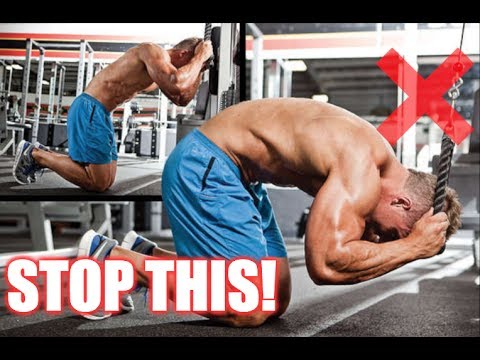
Use this once bodyweight crunches get easy and you want to add real load without going back to a loaded sit-up. Because you’re kneeling and curling down toward the floor instead of lying flat and curling up, your lower back never has to press against anything or take shear force the way it can on a weighted sit-up. I run this for 3 to 4 sets of 12 to 15 reps, and it’s my pick for a dedicated ab day.
How to Perform Cable Crunches
- Attach a rope to a high pulley and kneel a foot or two in front of the stack, facing it.
- Hold the rope by your ears or temples with both hands and let the weight pull your torso up slightly.
- Curl your torso down by rounding your spine and bringing your elbows toward your knees, keeping the bend in your spine rather than your hips.
- Extend back up under control to the starting position.
Equipment: cable machine, rope attachment.
This video from Colossus Fitness shows how to perform the kneeling cable crunch.
Tips for Cable Crunches
- Round your spine instead of just hinging at your hips. Keeping your hip flexors out of it is the whole point of this exercise.
- Keep the weight light enough that you can control the rep. This isn’t a lift you want to lower fast.
- Keep your hips stacked over your knees instead of sitting back toward your heels.
- Squeeze hard at the bottom of each rep for a full second before you extend back up.
For more weighted, cable-only ab options, see our cable ab exercises roundup.
4. Reverse Crunch
When to Perform Reverse Crunches
This is the option I’d pick if your neck is the problem, since your hands never touch your head at all. Only your hips and lower back curl a few inches off the floor, so you get real lower ab work without your spine ever going through the big range a sit-up asks for. I’d program 3 sets of 12 to 15 reps, either after crunches or on their own on a lighter ab day.
How to Perform Reverse Crunches
- Lie on your back with your knees bent and pull your knees up toward your chest, feet off the floor.
- Press your palms flat on the floor at your sides for support.
- Curl your hips and lower back up off the floor by contracting your lower abs, bringing your knees toward your chest.
- Lower your hips back down under control without letting your feet touch the floor between reps.
Equipment: none.
This video from PureGym shows how to perform the reverse crunch.

Tips for Reverse Crunches
- Move slowly. Momentum from swinging your legs takes the work away from your abs.
- Keep your lower back rounded as it lifts, rather than arching.
- Stop the rep once your hips lift off the floor. You don’t need to bring your knees all the way to your face.
- If your lower back still feels it, keep your knees bent tighter to shorten the lever.
5. V-Up
When to Perform V-Ups
This is a tougher bodyweight option that hits your upper and lower abs in the same rep, since your torso and legs both fold up toward each other at once. It’s tougher on your lower back than most of the other options here, so save it for once your abs are strong enough to control the movement rather than using it as your first swap. Stick to 3 sets of 8 to 12 reps.
How to Perform V-Ups
- Lie flat on your back with your arms extended overhead and your legs straight.
- Simultaneously lift your torso and legs, reaching your hands toward your toes.
- Balance briefly at the top in a V shape, with only your glutes touching the floor.
- Lower your torso and legs back down together under control.
Equipment: none.
This video from ScottHermanFitness shows how to perform the V-up.

Tips for V-Ups
- Keep your legs as straight as you can. Bending your knees turns this into an easier, different exercise.
- If a full V-up is too hard, bend your knees or work one leg at a time until you build up the strength.
- Move with control instead of throwing your torso up to meet your legs.
- Exhale hard at the top of each rep to get a full contraction.
6. Ab Wheel Rollout
When to Perform Ab Wheel Rollouts
Use this once you want your abs working to resist movement instead of just creating it. A rollout trains your abs to keep your spine still while your arms and the wheel try to pull it into extension, which is a different skill than the spinal flexion a sit-up trains, but it still lights up your entire core hard. I’d program 3 sets of 8 to 12 reps from your knees, and I wouldn’t start here if you’ve never trained your core this way before.
How to Perform Ab Wheel Rollouts
- Kneel on a mat or pad and grip the ab wheel handles with both hands.
- Brace your abs and slowly roll the wheel forward, extending your body out.
- Go as far as you can while keeping your lower back from sagging or arching.
- Reverse the motion and pull the wheel back toward your knees using your abs, not your hip flexors.
Equipment: ab wheel.
This video from Be a Game Character shows how to perform kneeling and standing ab wheel rollouts.

Tips for Ab Wheel Rollouts
- Stop the rollout the moment your lower back starts to sag. That’s the point where the range exceeds your current strength.
- Keep your arms mostly straight and let your torso do the work, not your shoulders.
- Start with a partial range of motion and build up to a full rollout over a few weeks.
- Use a mat under your knees. The pressure adds up fast on a hard floor.
If a wheel isn’t practical for your gym, see our ab rollout alternatives.
7. Plank
When to Perform Planks
This is the most back-friendly option on the entire list, since your spine never flexes at all. You’re just holding a straight line from your head to your heels while your abs fight to keep you there, which makes it the exercise I’d start with if your lower back is the whole reason you’re avoiding sit-ups in the first place. Hold for 30 to 60 seconds for 3 sets, and add time before you add anything fancier. It’s also the easiest exercise on this list to fit in anywhere, since a minute of floor space is all you ever need.
How to Perform Planks
- Get into a push-up position, then drop down onto your forearms.
- Keep your elbows under your shoulders and your body in a straight line from head to heels.
- Brace your abs and squeeze your glutes to keep your hips from sagging or piking up.
- Hold the position while breathing normally, instead of holding your breath.
Equipment: none.
This video from NASM shows how to perform the plank with correct form.

Tips for Planks
- Keep your hips level with your shoulders. A sagging or piked hip means the set is over.
- Squeeze your glutes. It takes some of the strain off your lower back.
- Look at the floor a foot or two in front of you instead of straight ahead, to keep your neck neutral.
- Once 60 seconds feels easy, add a weight plate on your back instead of just holding longer.
If planks bother your shoulders or wrists, see our plank alternatives.
8. Dead Bug
When to Perform Dead Bugs
This is the gentlest option here, and it’s the one I’d hand to someone easing back into ab training after a back tweak. Your lower back stays pressed flat against the floor the entire set, so you’re training your abs to brace and control your spine instead of asking your spine to move at all. Run 3 sets of 8 to 10 reps per side, slow and controlled.
How to Perform Dead Bugs
- Lie on your back with your arms reaching straight up toward the ceiling and your knees bent at 90 degrees over your hips.
- Press your lower back flat into the floor and keep it there for the whole set.
- Slowly extend one arm overhead and the opposite leg straight out, just above the floor.
- Return to the starting position and repeat on the other side.
Equipment: none.
This video from NASM shows how to perform the dead bug.

Tips for Dead Bugs
- Keep your lower back pinned to the floor the entire set. The moment it arches, you’ve gone too far with your arm and leg.
- Move slowly. This isn’t an exercise where speed helps you.
- Breathe normally instead of holding your breath through each rep.
- Only extend your arm and leg as far as you can while keeping your back flat, even if that’s a small range at first.
Reasons to Choose a Sit-Up Alternative
There are a few good reasons to swap the sit-up for one of the options above. None of these are a downgrade, and a few of them will train your abs harder than a sit-up ever did. Most lifters land here for one of two reasons: something hurts during a sit-up, or the sit-up stopped doing much for their abs a long time ago.
- Your lower back doesn’t like the range. Crunches, reverse crunches, and dead bugs keep your spine in a shorter or fully supported position instead of curling your whole torso up off the floor.
- Your neck takes a beating. Skip anything where your hands pull on your head. The reverse crunch, plank, and dead bug never put your hands near your neck at all.
- You don’t have anything to anchor your feet under. Every option on this list works without a partner holding your feet or a machine to lock them in.
- You want to isolate your abs from your hip flexors. The crunch and cable crunch keep the range short enough that your abs do almost all the work.
- You’ve stalled on sit-ups. A fresh stimulus like the ab wheel rollout or hanging leg raise will challenge your core in a way months of sit-ups stopped doing.
- You want ab work you can add real weight to over time. Bodyweight sit-ups run out of progression fast. The cable crunch and a weighted plank let you keep adding load for years.
For more ways to bring up a core that’s stopped responding, see our underdeveloped core and underdeveloped abs guides.
Muscles Worked by the Sit-Up
Your rectus abdominis, the long muscle that runs down the front of your torso and gives you a six-pack when it’s visible, does most of the flexion work on a sit-up. Your hip flexors kick in hard once your torso passes about 30 degrees off the floor, which is why a full sit-up trains your hips almost as much as your abs. That’s actually the biggest mechanical difference between a sit-up and a crunch. A crunch stops before your hip flexors get heavily involved, while a full sit-up asks them to finish the rep. The sit-up and its other alternatives split that work up differently depending on the exercise, and knowing which muscle each one biases is the easiest way to pick the right swap.
- Rectus abdominis: the primary mover on a sit-up, crunch, reverse crunch, and V-up. It’s what curls your spine forward, and it’s the muscle most people are trying to train when they pick one of these exercises.
- Hip flexors (psoas major, iliacus, rectus femoris): heavily involved once your torso passes the halfway point of a sit-up, and the main driver on hanging leg raises. If you want to isolate your abs away from your hips, the crunch and cable crunch keep this involvement low.
- Obliques: work as stabilizers on most of these exercises, but they’re loaded hardest on the ab wheel rollout and dead bug, where they resist your spine twisting or extending.
- Transverse abdominis: your deepest ab muscle, and the main target of the plank and dead bug. It doesn’t move your spine. It braces it.
- Erector spinae: works to control the lowering phase on the sit-up and V-up, and to keep your spine from sagging on the plank and ab wheel rollout.
All of these exercises train flexion, curling your spine forward or resisting it from moving. Training your core against rotation instead is a different pattern entirely, covered in our pallof press alternatives guide.
FAQs
Are sit-ups bad for your back?
Not inherently, but they’re rougher on your spine than most other ab exercises, and that adds up over hundreds of reps. Repeatedly flexing your spine under load is the kind of stress that tends to catch up with people, especially if your form breaks down as you fatigue or you’re doing them on a hard floor with no support. If your back already bothers you, or you’re doing high-rep sit-ups a few times a week, swapping in a few of the options above is a smart trade, not an overreaction.
What’s the closest alternative to a sit-up?
The crunch. It trains the same rectus abdominis through the same direction of movement, just over a shorter range, so it feels familiar the first time you try it. If you specifically want to keep the longer range of motion a sit-up gives you but take the strain off your lower back, the reverse crunch is the next best swap.
Can I build ab strength without doing sit-ups?
Yes. Your abs grow and get stronger from being loaded through a range of motion with enough volume over time, and they don’t care whether that load comes from a sit-up, a crunch, a cable, or your own bodyweight held in a plank. Any exercise on this list will build your abs if you train it hard and progress it, whether that means more reps, more resistance, or a longer hold.
What’s the best sit-up alternative for a bad back?
The dead bug and the plank. Neither one asks your spine to flex at all, which is usually what triggers lower back pain on a sit-up in the first place. Start with those two, build up your reps and hold times, and only add an exercise that flexes your spine, like the crunch, once your back feels ready for it.
What’s the best sit-up alternative for a sore neck?
The reverse crunch, dead bug, or plank. None of them put your hands anywhere near your head, so there’s nothing to pull on. If a crunch still bothers your neck, cross your arms over your chest instead of touching your head at all.
What’s the best sit-up alternative at home with no equipment?
The crunch, reverse crunch, V-up, plank, and dead bug all need nothing but floor space. That covers a full ab workout without a single piece of equipment. If you pick up a pull-up bar or an ab wheel later, the hanging leg raise and ab wheel rollout are worth adding for more resistance.
How many ab exercises should I do per workout?
One or two is plenty on a day where you’re also squatting or deadlifting, since your abs already work hard to brace those lifts. On a dedicated ab day, 2 to 3 exercises covering different patterns, like a crunch, a hanging leg raise, and a plank, will train your abs well without piling on junk volume.
Key Takeaways
If your lower back is the reason you’re here, start with the plank or dead bug and build up from there before you touch anything that flexes your spine under load. If it’s your neck that bothers you, the reverse crunch keeps your hands off your head entirely. Chasing more ab strength and size, the hanging leg raise and cable crunch let you add real resistance over time in a way bodyweight work can’t. And if you just want the simplest one-for-one swap, the crunch trains the same muscle through a shorter, safer range. Pick two or three that fit your equipment and how your back and neck feel. You don’t need all eight in the same program.
Other Alternative Exercises
If you enjoyed this post, check out our other roundups of the best alternatives for other exercises.