The crunch is the classic ab isolation exercise. You lie on your back with your knees bent, curl your shoulder blades a few inches off the floor by flexing your spine, then lower back down. Unlike a sit-up, you’re not bringing your whole torso up to your knees, just rounding your upper spine enough to squeeze your abs. It’s simple, it needs no equipment, and it trains your rectus abdominis directly through the exact motion that makes your abs shorten and contract.
You might still want to swap it out. Repeated spinal flexion can irritate your lower back or neck once you’re doing high reps a few times a week, especially if your form breaks down and you start yanking on your neck to get your shoulders up. A plain crunch also plateaus fast since your bodyweight is the only resistance, and it doesn’t do much for your obliques or your lower abs on its own. Maybe you just want a version you can load with weight, or one that trains the same muscle from a completely different angle.
Here are the 8 crunch alternatives I reach for most, picked for how well they train your abs through spinal flexion or anti-flexion, how easy they are on your neck and lower back, and what equipment they need. Some of these are close bodyweight swaps you could run in the exact same program slot, a couple let you add real weight, and a few skip flexion entirely for lifters whose backs don’t tolerate it well. I’ll tell you when to use each one and exactly how to do it.
Table of Contents
- 1 The 8 Best Crunch Alternatives
- 2 Reasons to Choose a Crunch Alternative
- 3 Muscles Worked by the Crunch
- 4 FAQs
- 5 Key Takeaways
- 6 Other Alternative Exercises
- 6.1 The 9 Best Seated Cable Row Alternatives (2026)
- 6.2 The 10 Best Overhead Press Alternatives
- 6.3 The 10 Best Lying Leg Curl Alternatives
- 6.4 The 8 Best Ab Rollout Alternatives
- 6.5 The 10 Best Glute Bridge Alternatives
- 6.6 The 7 Best Deadlift Alternatives
- 6.7 The 9 Best T-Bar Row Alternatives
- 6.8 The 10 Best Bulgarian Split Squat Alternatives
- 6.9 The 10 Best Bench Press Alternatives
- 6.10 The 10 Best Bent Over Row Alternatives
- 6.11 The 9 Best Barbell Row Alternatives
- 6.12 The 9 Best Lunge Alternatives
- 6.13 The 10 Best Dumbbell Pullover Alternatives
- 6.14 The 12 Best Pull-Up Alternatives
- 6.15 The 8 Best Decline Bench Press Alternatives
The 8 Best Crunch Alternatives
- Cable Crunch
- Reverse Crunch
- Hanging Leg Raise
- Decline Sit-Up
- Bicycle Crunch
- V-Up
- Dead Bug
- Hollow Body Hold
1. Cable Crunch
When to Perform Cable Crunches
This is the version I go to once bodyweight crunches stop being a challenge, since a cable stack lets you add load the same way you’d add plates to a squat. It’s still the same spinal flexion pattern as a crunch, just weighted and kneeling instead of flat on the floor. Use it as a main ab exercise on a dedicated core day, for 3 to 4 sets of 10 to 15 reps, and add weight every week or two once your current load feels easy for the full set. Plenty of home lifters skip this one just because they don’t have a cable stack, but any gym with a lat pulldown or functional trainer has everything you need.
How to Perform Cable Crunches
- Attach a rope to a high pulley and kneel a couple of feet in front of the stack, facing it.
- Grab the rope with both hands and hold it against your forehead or the back of your neck, not your chest.
- Keeping your hips still, curl your torso down by flexing your spine, bringing your elbows toward your knees.
- Slowly return to the upright kneeling position under control, without letting your hips shift back to help.
Equipment: cable machine, high pulley, rope attachment.
This video from Colossus Fitness shows how to perform the kneeling cable abdominal crunch.

Tips for Cable Crunches
- Move from your spine, not your hips. If your hips are rocking back and forth, you’re turning it into a hip hinge instead of an ab exercise.
- Keep the rope close to your head the whole time instead of pulling with your arms.
- Round your upper back on the way down like you’re trying to look at your belly button.
- Start lighter than you think, since the kneeling position exposes bad form fast.
Want more cable-only ab options? See our cable ab exercises roundup.
2. Reverse Crunch
When to Perform Reverse Crunches
A regular crunch curls your upper body toward your hips. A reverse crunch flips that, curling your hips and lower spine toward your rib cage instead, so it’s the pick when your lower abs aren’t keeping up with the rest of your midsection. It’s also easier on your neck since your hands aren’t behind your head pulling on it. I’d program 3 sets of 12 to 15 reps, either paired with a regular crunch or on its own.
How to Perform Reverse Crunches
- Lie on your back with your arms flat at your sides, palms down, and your knees bent to 90 degrees.
- Lift your feet off the floor so your shins are roughly parallel to the ground.
- Curl your hips and lower back up off the floor, bringing your knees toward your chest.
- Lower your hips back down under control until your lower back touches the floor again.
Equipment: none.
This video from PureGym shows how to perform the reverse crunch.

Tips for Reverse Crunches
- Lift with your lower abs, not momentum. A fast, swinging rep means the weight of your legs is doing the work instead of your abs.
- Keep a small curl in your lower back at the top instead of just rocking your knees toward your face.
- Press your palms into the floor for a little extra stability if your hips want to twist.
- Once bodyweight reps stop being hard, slow the tempo down before you add anything else.
If your lower abs are the weak link in your midsection, our guide to growing underdeveloped abs covers more exercises worth adding.
3. Hanging Leg Raise
When to Perform Hanging Leg Raises
This is the most demanding exercise on the list, and it’s the one I use once someone has built up real ab strength and grip endurance from the other options here. It trains your lower abs and hip flexors together through a long range of motion, and it doubles as a grip and shoulder stability drill since you’re hanging the entire set. I’d program 3 sets of 8 to 12 reps, saved for early in a session while your grip is still fresh.
How to Perform Hanging Leg Raises
- Hang from a pull-up bar with an overhand grip, hands just outside shoulder width, and let your body hang straight.
- Brace your abs and keep your ribs pulled down instead of letting your lower back arch.
- Raise your legs, keeping them straight or bending your knees slightly, until they’re at least parallel to the floor.
- Lower your legs back down under control without swinging or using momentum to reset.
Equipment: pull-up bar (a captain’s chair with arm pads is a good regression if a full hang is too much on your grip).
This video from ATHLEAN-X shows how to perform the hanging leg raise.

Tips for Hanging Leg Raises
- Tuck your ribs down toward your hips at the top of every rep instead of just lifting your legs.
- Bend your knees to make it easier, or add a slight posterior pelvic tilt at the top to make it harder without adding reps.
- Don’t let your legs swing between reps. Pause briefly at the bottom to kill any momentum.
- Use lifting straps once your grip gives out before your abs do.
If a full hanging leg raise feels like too much too soon, our ab rollout alternatives guide covers other advanced core moves with easier entry points.
4. Decline Sit-Up
When to Perform Decline Sit-Ups
A decline sit-up gives you a bigger range of motion than a crunch, since you’re lowering all the way back onto an angled bench instead of stopping a few inches off the floor. That extra stretch at the bottom means your abs are working through more of their length each rep. Use it once a regular crunch feels too short a range for you, or when you want to hold a plate across your chest to add load. Stick to 3 sets of 10 to 15 reps, and only add weight once your bodyweight form is solid.
How to Perform Decline Sit-Ups
- Set a decline bench to a moderate angle and hook your feet under the ankle pads.
- Lie back with your arms crossed over your chest or lightly touching your temples.
- Curl your torso up off the bench, leading with your chest, until you’re sitting upright.
- Lower yourself back down under control, letting your spine round back onto the bench one segment at a time.
Equipment: decline bench (a weight plate held across your chest is optional once bodyweight gets easy).
This video from ScottHermanFitness shows how to perform the decline sit-up.

Tips for Decline Sit-Ups
- Start at a shallow decline angle and only steepen it once your abs, not your hip flexors, are doing most of the work.
- Round your spine on the way up instead of keeping your back flat and hinging at the hips like a stiff board.
- If your lower back complains at the bottom, stop a few inches short of the bench instead of lying all the way back.
- Hold a plate at arm’s length overhead instead of on your chest for extra difficulty without changing the angle.
5. Bicycle Crunch
When to Perform Bicycle Crunches
Reach for this when a plain crunch has your rectus abdominis covered but your obliques are getting left out. The rotation, bringing your elbow toward the opposite knee, hits the sides of your waist in a way a straight-line crunch never will. It’s also equipment-free, so it’s a good fit for a home workout or a finisher at the end of any session. I’ll run 3 sets of 15 to 20 total reps, counting each side as one rep.
How to Perform Bicycle Crunches
- Lie on your back with your hands lightly behind your head and your knees pulled up toward your chest.
- Extend one leg out straight while rotating your torso to bring the opposite elbow toward your bent knee.
- Switch sides, extending the other leg while rotating to bring the other elbow across.
- Keep alternating sides in a slow, controlled pedaling motion.
Equipment: none.
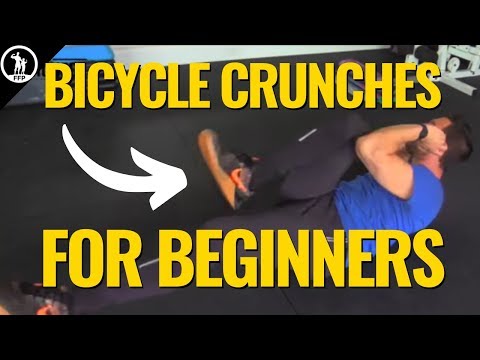
This video from Fit Father Project shows how to perform bicycle crunches with proper form.
Tips for Bicycle Crunches
- Rotate from your ribs, not your elbow. Yanking on your neck with your hand is a fast way to make your neck sore instead of your abs.
- Slow the tempo down. A fast, flailing pace turns this into a cardio drill instead of an ab exercise.
- Keep your lower back pressed toward the floor through the whole set.
- Extend your bottom leg fully instead of letting it stay bent, since a straight leg makes the rotation work harder.
For more exercises that target the sides of your waist directly, see our growing underdeveloped obliques guide.
6. V-Up
When to Perform V-Ups
This is the most advanced bodyweight option here, since you’re lifting both your upper and lower body off the floor at the same time to fold into a V shape. It trains your abs through a longer range than a crunch and adds a real hip flexor and coordination demand on top of it. Save it for once you can do 15 to 20 clean reverse crunches or bicycle crunches without your form falling apart. I’d program 3 sets of 8 to 12 reps.
How to Perform V-Ups
- Lie flat on your back with your arms extended overhead and your legs straight.
- Simultaneously lift your legs and your upper body off the floor, keeping both roughly straight.
- Reach your hands toward your feet at the top, forming a V shape with your body.
- Lower your arms and legs back down together under control, stopping just short of the floor.
Equipment: none.
This video from Live Lean TV Daily Exercises shows how to perform the V-up.

Tips for V-Ups
- Bend your knees slightly if straight legs make your lower back arch off the floor.
- Reach through your fingertips instead of just curling your shoulders up, since that keeps you strict about lifting your whole torso.
- Stop the set once your form starts breaking down. A sloppy V-up with your back arching does more harm than good.
- Regress to alternating V-ups, lifting one arm and the opposite leg at a time, if the full version is still too hard.
V-ups demands serious core stability to keep your torso from twisting. If you want to build that anti-rotation strength directly, check out our pallof press alternatives guide.
7. Dead Bug
When to Perform Dead Bugs
This is the pick if crunches themselves are the problem, whether that’s your lower back, your neck, or just general discomfort with repeated spinal flexion. There’s no rounding of your spine at all. Instead you’re training your abs to keep your lower back flat and still while your arms and legs move, which is a skill that carries over to almost everything else you lift. I like it as a warm-up drill or on days your back needs a break from flexion work, for 2 to 3 sets of 8 to 10 reps per side.
How to Perform Dead Bugs
- Lie on your back with your arms reaching straight up toward the ceiling and your hips and knees bent to 90 degrees.
- Press your lower back flat into the floor and brace your abs before you move.
- Slowly lower one arm overhead and the opposite leg toward the floor at the same time, keeping your lower back pinned down.
- Return to the starting position and repeat with the opposite arm and leg.
Equipment: none.
This video from NASM shows how to perform the dead bug with proper form.

Tips for Dead Bugs
- If your lower back lifts off the floor at any point, you’ve lowered your arm or leg too far. Shorten the range.
- Move slowly. This exercise loses most of its value if you rush through the reps.
- Breathe normally instead of holding your breath, since the point is control under motion, not a max isometric squeeze.
- Add a light band around your foot or a small plate in your hand once the bodyweight version gets easy.
Looking for other back-friendly core options? Our plank alternatives guide covers more anti-extension moves that skip spinal flexion entirely.
8. Hollow Body Hold
When to Perform Hollow Body Holds
This is the isometric version of a crunch. Instead of repeatedly curling your spine, you hold a slight flexed position under tension the whole set. It’s a staple in gymnastics for a reason, since it trains your abs to keep your ribs pulled down and your lower back flat while your arms and legs are extended, which is real carryover for handstands, overhead pressing, and heavy squats or deadlifts where your core has to resist your spine extending. Use it as a finisher or a core-specific block, holding for 20 to 40 seconds across 3 sets.
How to Perform Hollow Body Holds
- Lie on your back and press your lower back flat into the floor.
- Extend your arms straight overhead and your legs straight out, both a few inches off the floor.
- Curl your shoulders and upper back slightly off the floor while keeping your lower back pinned down.
- Hold the position, keeping your lower back in contact with the floor the entire time.
Equipment: none.
This video from Men’s Health shows how to perform and check your hollow body hold form.

Tips for Hollow Body Holds
- If your lower back arches off the floor, bend your knees or bring your arms down by your sides until you can hold the position without arching.
- Stop the set the moment your lower back lifts, not when the timer runs out. A broken hold with an arched back trains the wrong pattern.
- Breathe through the hold instead of bracing so hard you hold your breath the whole time.
- Rock gently side to side once a static hold gets easy, keeping the hollow position intact, for an added challenge.
For more ways to build core stability alongside your ab work, see our growing underdeveloped core guide.
Reasons to Choose a Crunch Alternative
There are a few good reasons to swap the crunch for one of the options above. None of them are a downgrade. Each one trains your abs through a real range of motion, and a few of them let you add weight or hold tension in a way a bodyweight crunch never will. Picking the right one comes down to matching the exercise to the actual reason you’re swapping, not just grabbing whatever’s popular.
- Your neck or lower back doesn’t like crunches. The dead bug and hollow body hold train your abs without repeated spinal flexion, so they’re the pick if that’s the actual problem.
- You’ve plateaued on bodyweight reps. The cable crunch and weighted decline sit-up let you keep progressing with load instead of just chasing more reps.
- Your obliques are lagging. The bicycle crunch adds rotation a straight-line crunch skips entirely.
- Your lower abs need direct work. The reverse crunch and hanging leg raise curl from your hips instead of your shoulders, hitting that region harder.
- You train at home with no equipment. The reverse crunch, bicycle crunch, V-up, dead bug, and hollow body hold all need nothing but floor space.
Muscles Worked by the Crunch
Your abs are built from a few distinct muscles that work together but do slightly different jobs, and the crunch and its alternatives above hit them in different proportions depending on the movement pattern. Knowing which muscle each exercise hits hardest makes it a lot easier to pick the right one for a specific weak point instead of guessing.
- Rectus abdominis: the primary target of a crunch and nearly every exercise on this list. It runs from your ribs to your pelvis and is responsible for flexing your spine, which is the exact motion a crunch, reverse crunch, decline sit-up, and V-up all train directly.
- Obliques: the muscles along the sides of your waist that handle rotation and side bending. They’re mostly along for the ride on a straight crunch, but the bicycle crunch trains them hard through its rotational pattern.
- Hip flexors: assist heavily on the reverse crunch, hanging leg raise, and V-up, since all three involve lifting your legs or hips toward your torso.
- Transverse abdominis: your deepest ab muscle, working like a corset to stabilize your spine. It’s the main muscle trained on the dead bug and hollow body hold, where the goal is keeping your spine still rather than moving it.
- Erector spinae: the muscles running along your spine that work isometrically to resist over-flexion on the dead bug and hollow body hold, giving your lower back some indirect training alongside your abs.
FAQs
What’s the closest alternative to a crunch?
The reverse crunch. It trains the same spinal flexion pattern as a regular crunch, just curling from the opposite end, and it needs the same amount of equipment, which is none. If you want a weighted version instead, the cable crunch is the closest loaded match.
Can I build abs without doing crunches?
Yes. Your abs respond to being loaded and worked through a range of motion over time, and that doesn’t have to come from spinal flexion specifically. A hollow body hold, dead bug, or hanging leg raise will build real ab strength and size without a single crunch rep, as long as you progress them with more time under tension, more reps, or more load. Plenty of lifters with visible, strong abs never do a traditional crunch at all and instead build everything from loaded carries, hanging work, and heavy compound lifts.
What’s the best crunch alternative for a bad back?
The dead bug and hollow body hold are the friendliest options, since neither one asks your spine to round under load. If your back is sensitive, start there and build up your core control before you reintroduce flexion-based exercises like the crunch or reverse crunch.
What’s the best crunch alternative at home?
The reverse crunch, bicycle crunch, dead bug, and hollow body hold all need nothing more than floor space. Between those four, you can cover your upper abs, lower abs, obliques, and deep core stability without ever leaving your living room.
Are crunches bad for your back?
Not inherently, but high reps of poor-form crunches over months can irritate your lower back and neck, especially if you’re pulling on your head to get your shoulders up. Keep your reps controlled and your hands lightly resting behind your head instead of yanking with them, and if your back is already sensitive, lean on the dead bug and hollow body hold instead.
How many ab exercises should I do per workout?
Two or three is plenty on most training days, covering a flexion exercise, a rotational exercise, and an anti-extension hold. Your abs also get worked indirectly on squats, deadlifts, and overhead presses, so you don’t need to hammer them from every angle every single session.
Key Takeaways
If you want the closest bodyweight swap, go with the reverse crunch. If you want to add real weight and keep progressing, the cable crunch is the one to build around. Training at home with nothing but floor space, the bicycle crunch and dead bug will cover your obliques and deep core stability between them. And if your neck or lower back is the reason you’re looking for a swap in the first place, start with the dead bug or hollow body hold before you try anything that loads your spine in flexion. Pick based on what your back can handle and what equipment you’ve got, and progress the same way you’d progress any other exercise: more reps, more time under tension, or more load over time. I wouldn’t program all 8 in one week. Pick two or three that match your goals and your equipment and run those consistently for a few months before you rotate in something new.
Other Alternative Exercises
If you enjoyed this post, check out our other roundups of the best alternatives for other exercises.