The cable curl is a standing biceps curl you perform off a low pulley, usually with a straight bar or EZ-bar attachment. You stand facing the machine, grip the bar, and curl it up toward your shoulders while your elbows stay pinned at your sides. Because the cable pulls at an angle instead of straight down, your biceps stay under tension through the entire rep, even at the top and bottom where a dumbbell or barbell curl goes slack. That constant tension is why the cable curl builds so much size for 3 sets of 10 to 15 reps at a time.
You might want an alternative for a few reasons. Not every gym has an open low pulley, and if you train at home you probably don’t have a cable stack at all. Cable curls also don’t let you load as heavy as a barbell or dumbbell curl, so if you’re chasing raw strength or a bigger arm on a budget of time, a free-weight option gets you there faster. Or maybe you’ve been running cable curls for months and your biceps have stopped responding, so you need a new stimulus to keep growing.
Here are the 8 cable curl alternatives I reach for most, picked for how well they keep tension on the biceps, how much weight you can load, and what equipment they need. Some of these are near-identical swaps you could run in the exact same program slot, and others are heavier compound-adjacent options for when you want to build strength and size at once. I’ll tell you when to use each one and exactly how to do it.
Table of Contents
- 1 The 8 Best Cable Curl Alternatives
- 2 Reasons to Choose the Cable Curl
- 3 Muscles Worked by the Cable Curl
- 4 FAQs
- 4.1 What’s the closest alternative to a cable curl?
- 4.2 Can I build bicep size without a cable machine?
- 4.3 What’s the best cable curl alternative for building the biceps peak?
- 4.4 What’s the best cable curl alternative at home?
- 4.5 Why do cable curls feel harder than dumbbell curls?
- 4.6 How many bicep exercises should I do per workout?
- 5 Key Takeaways
- 6 Other Alternative Exercises
- 6.1 The 9 Best Barbell Row Alternatives
- 6.2 The 9 Best Lunge Alternatives
- 6.3 The 8 Best Decline Bench Press Alternatives
- 6.4 The 10 Best Pallof Press Alternatives
- 6.5 The 10 Best Lying Leg Curl Alternatives
- 6.6 The 10 Best Dumbbell Pullover Alternatives
- 6.7 The 10 Best Bulgarian Split Squat Alternatives
- 6.8 The 9 Best T-Bar Row Alternatives
- 6.9 The 9 Best Pendlay Row Alternatives
- 6.10 The 10 Best Bench Press Alternatives
- 6.11 The 12 Best Pull-Up Alternatives
- 6.12 The 10 Best Hack Squat Alternatives
- 6.13 The 9 Best Leg Press Alternatives
- 6.14 The 10 Best Front Squat Alternatives
- 6.15 The 8 Best Tricep Dip Alternatives
The 8 Best Cable Curl Alternatives
- Dumbbell Curl
- Hammer Curl
- Barbell Curl
- Preacher Curl
- Incline Dumbbell Curl
- Bayesian Cable Curl
- Resistance-Band Curl
- Machine Bicep Curl
1. Dumbbell Curl
When to Perform Dumbbell Curls
This is the closest swap I’ve got for a cable curl. You still isolate your biceps with your elbows locked at your sides, just with free weights instead of a machine. Use it when your gym’s cable stations are all taken, when you train at home with nothing but a pair of dumbbells, or when you want to check for a strength imbalance between your left and right arm. I usually program it for 3 sets of 8 to 12 reps, either in the same slot a cable curl would sit in or paired with a compound pull earlier in the session.
How to Perform Dumbbell Curls
- Stand holding a dumbbell in each hand, arms fully extended, palms facing forward.
- Keep your elbows pinned to your sides and your upper arms still for the whole set.
- Curl one dumbbell up toward your shoulder while rotating your palm slightly if it feels natural, then lower it under control.
- Curl the other arm, alternating back and forth, or curl both together if you’d rather keep it simple.
Equipment: a pair of dumbbells.
This video from Buff Dudes Workouts shows how to perform the alternating dumbbell curl.

Tips for Dumbbell Curls
- Keep your elbows locked at your sides. If they drift forward, your front delts start taking over.
- Don’t swing the weight up with your hips. If you need momentum to finish a rep, the dumbbell is too heavy.
- Alternating arms lets you focus on one side at a time and fix a lagging arm.
- Control the lowering phase instead of just dropping the weight back down.
For a full breakdown of how a free-weight curl stacks up against a bar curl, see our barbell curl vs dumbbell curl comparison.
2. Hammer Curl
When to Perform Hammer Curls
Reach for this when your elbows or wrists don’t love a fully supinated grip, or when you want to build your brachialis and forearms along with your biceps. The neutral grip takes some of the twisting stress off your elbow joint compared to a standard curl, so it’s a lift I’ll rotate in for lifters coming back from elbow soreness. I’ll run this for 3 sets of 10 to 12 reps, usually right after a heavier curl variation.
How to Perform Hammer Curls
- Stand holding a dumbbell in each hand with your palms facing your body, thumbs pointed forward.
- Pin your elbows to your sides and keep your upper arms still.
- Curl the dumbbells up toward your shoulders, keeping your palms facing each other the entire rep.
- Lower the dumbbells back down under control until your arms are straight.
Equipment: a pair of dumbbells.
This video from Buff Dudes Workouts shows how to perform the hammer curl.

Tips for Hammer Curls
- Keep your wrists straight instead of bending them toward your body at the top.
- Don’t let your palms rotate. A neutral grip is what puts the emphasis on your brachialis.
- You can usually load hammer curls a bit heavier than a standard curl, since your forearm and brachialis are stronger in this position.
- Cross-body hammer curls, where you curl the dumbbell toward the opposite shoulder, are a good variation once the standard version gets easy.
If you want more hammer curl variations, see our full hammer curl alternatives guide.
3. Barbell Curl
When to Perform the Barbell Curl
This is the heaviest loading option on the list, so use it when you want to add real strength and size to your biceps instead of just chasing a pump. Both hands move together on a fixed bar, so you can load more total weight than you could with a pair of dumbbells or a cable stack. I’d program this for 3 to 4 sets of 6 to 10 reps, usually at the start of an arm day while you’re fresh.
How to Perform the Barbell Curl
- Stand holding a barbell with an underhand, shoulder-width grip, arms fully extended.
- Pin your elbows to your sides and brace your core.
- Curl the bar up toward your shoulders without letting your elbows drift forward.
- Lower the bar back down under control to a full stretch.
Equipment: a barbell (an EZ-bar is a good substitute if a straight bar bothers your wrists).
This video from Buff Dudes Workouts shows how to perform the barbell curl.

Tips for the Barbell Curl
- Keep your elbows still. Swinging them forward at the top turns this into a front raise.
- Don’t lean back to finish a rep. If you’re arching your lower back, drop the weight.
- A shoulder-width grip is a good default, but a slightly wider grip shifts more work to the short head, and a narrower grip shifts more to the long head.
- Squeeze at the top for a second before lowering instead of rushing straight into the next rep.
Curious how a bar curl compares to a free-weight curl? See our barbell curl vs dumbbell curl breakdown.
4. Preacher Curl
When to Perform Preacher Curls
Use this when you want to take momentum completely out of the equation. Your upper arms rest on the pad, so you can’t swing your elbows back to cheat a rep the way you can standing. That makes it one of the best options for isolating the short head of your biceps and building a strict mind-muscle connection. I’ll run this for 3 sets of 10 to 12 reps, usually as a finisher after a heavier standing curl.
How to Perform Preacher Curls
- Sit at a preacher bench and rest the backs of your upper arms flat against the pad.
- Grip an EZ-bar or barbell with an underhand grip, arms extended but not locked out.
- Curl the bar up toward your shoulders, keeping your upper arms pinned to the pad.
- Lower the bar back down under control until your arms are almost straight.
Equipment: a preacher bench and an EZ-bar, barbell, or dumbbells.
This video from Bodybuilding.com shows how to perform the preacher curl.

Tips for Preacher Curls
- Don’t lock your elbows out at the bottom. That shifts the stress off your biceps and onto the joint itself.
- Keep your chest against the pad instead of leaning back to finish a rep.
- Go lighter than you think. The strict form takes away the momentum you’re used to relying on with a standing curl.
- Single-arm dumbbell preacher curls are a good variation for fixing a lagging arm.
5. Incline Dumbbell Curl
When to Perform Incline Dumbbell Curls
This is the pick when you want the deepest stretch on your biceps of anything on this list. Sitting back on an incline bench pulls your arms behind your torso, so your biceps start each rep already lengthened, which is where most muscle growth research points for hypertrophy. Use it once a heavier compound curl is done and you want to finish your biceps off. I’ll run this for 3 sets of 10 to 12 reps, staying lighter than a standing dumbbell curl since the stretched position is more demanding.
How to Perform Incline Dumbbell Curls
- Set an adjustable bench to roughly a 45 to 60 degree incline.
- Sit back with your shoulders flat against the pad and let your arms hang straight down, holding a dumbbell in each hand.
- Curl the dumbbells up toward your shoulders without letting your elbows drift forward.
- Lower the dumbbells back down until your arms are fully straight behind your torso.
Equipment: an incline bench and a pair of dumbbells.
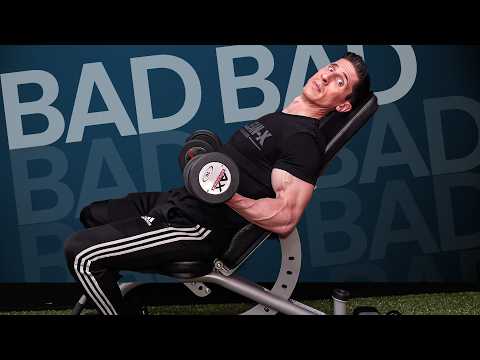
This video from ATHLEAN-X shows how to perform the incline dumbbell curl with proper form.
Tips for Incline Dumbbell Curls
- Keep your shoulders pressed against the pad. Letting them roll forward turns this into a standing curl with extra steps.
- Go lighter than your usual dumbbell curl weight. The stretched bottom position is the hardest part of the rep.
- Don’t let your elbows drift in front of your torso as you curl. Keep them pointing straight down.
- A slow lowering phase, around 3 seconds, is where most of the benefit of this exercise comes from.
6. Bayesian Cable Curl
When to Perform the Bayesian Cable Curl
This is my pick for the deepest stretch you can get from a cable, and it’s a genuinely different stimulus than a standard cable curl even though it uses the same machine. Facing away from the stack pulls your arm behind your torso at the bottom of the rep, so your long head starts under real tension instead of loose. Use it once you’ve got standard cable curls down and want another angle, or any time you only have one working handle free. I’ll run this for 3 sets of 10 to 12 reps per arm, usually toward the end of an arm day.
How to Perform the Bayesian Cable Curl
- Set a single-handle attachment to the lowest pulley on a cable stack.
- Grip the handle with one hand and step forward, facing away from the machine, until your arm is pulled slightly behind your torso.
- Keep your upper arm still and curl the handle up toward your shoulder.
- Lower it back down under control until you feel a full stretch behind your body.
Equipment: cable machine, single-handle attachment.
This video from Live Lean TV Daily Exercises shows how to perform the single-arm face-away Bayesian cable curl.

Tips for the Bayesian Cable Curl
- Step far enough forward that you feel real tension on your arm the moment it’s fully extended behind you.
- Keep your torso upright instead of leaning forward to help the weight up.
- Go lighter than a standard cable curl. The stretched starting position is unfamiliar and demanding on its own.
- If your shoulder complains at the bottom, shorten the range slightly instead of forcing the full stretch.
Want more low-pulley cable options? See our cable bicep exercises roundup.
7. Resistance-Band Curl
When to Perform Resistance-Band Curls
This is your no-equipment-in-a-gym option, the one you can throw in a suitcase and still get a real biceps workout on the road. A band mimics the constant tension of a cable curl since it gets harder to stretch the further you pull it, so this is the closest thing to a cable curl you can do without a machine. Bands are sized by resistance rather than a fixed weight, so pick one that gets genuinely hard by rep 12 to 15 and run 3 sets there.
How to Perform Resistance-Band Curls
- Stand on the middle of a resistance band with both feet, holding one end in each hand.
- Keep your elbows pinned to your sides, palms facing forward.
- Curl your hands up toward your shoulders against the band’s resistance.
- Lower back down under control, resisting the band the whole way instead of letting it snap your arms straight.
Equipment: one resistance band.
This video from Bodylastics shows how to perform the standing biceps curl with resistance bands.

Tips for Resistance-Band Curls
- Stand on the band with a wider foot stance for more resistance, or a narrower stance for less.
- Keep tension on the band at the bottom of the rep instead of letting it go fully slack.
- Carry two or three bands of different resistance if you travel often, since one band rarely covers every rep range you’ll want.
- Anchor the band under a door or a heavy object instead of your feet if you want a different angle of pull.
8. Machine Bicep Curl
When to Perform the Machine Bicep Curl
Use this when you want a strict, locked-in curl without having to worry about balance or bar path at all. The seat and arm pad fix your position for you, so it’s a solid choice late in a workout when your form on free-weight curls starts to break down. It’s also an easy way to push closer to failure safely, since there’s no dumbbell to drop or bar to lose control of. I’ll run this for 3 sets of 10 to 15 reps as one of the last biceps exercises in a session.
How to Perform the Machine Bicep Curl
- Sit down and adjust the seat so your upper arms rest flat against the pad.
- Grip the handles with an underhand grip, arms extended.
- Curl the handles up toward your shoulders, keeping your upper arms pinned to the pad.
- Lower back down under control until your arms are almost fully straight.
Equipment: a seated bicep curl machine.
This video from Live Lean TV Daily Exercises shows how to perform the seated machine bicep curl.

Tips for the Machine Bicep Curl
- Adjust the seat height before you touch the weight. A pad set too low or high shifts the stress onto your shoulders.
- Don’t shrug your shoulders up to help finish a rep. Keep them down and relaxed.
- Machines vary a lot between gyms, so spend your first set finding a weight that lets you feel the movement before you push hard.
- Single-arm machine curls, if your gym has one, let you focus on one side at a time the same way a dumbbell curl does.
Reasons to Choose the Cable Curl
The cable curl earns its spot in plenty of arm-day routines, and it’s worth knowing why before you swap it out for good. None of the alternatives above are a downgrade, but each one trades away something the cable curl does well. I still program cable curls myself most weeks, usually as the second or third biceps exercise once a heavier free-weight curl has done the bulk of the loading.
- Constant tension. The cable never goes slack, so your biceps work through the entire rep instead of resting at the top or bottom the way they do on a dumbbell or barbell curl.
- Adjustable angles. You can change the cable’s height, the attachment, and your stance to shift emphasis around your biceps without switching machines.
- Joint-friendly loading. The pulley smooths out the resistance curve compared to free weights, which is easier on your elbows if heavy barbell curls bother them.
- Easy to progress. Most cable stacks adjust in small increments, so you can add a little weight every week without big jumps.
If you’re comparing it directly against another isolation curl, see our concentration curl vs bicep curl breakdown.
Muscles Worked by the Cable Curl
Your biceps brachii sits on the front of your upper arm and has two heads, the long head and the short head, that both cross the elbow. Only the long head also crosses the shoulder, which is why exercises like the incline dumbbell curl and the Bayesian cable curl, that pull your arm behind your torso, load it harder than a standing curl does. The cable curl and its alternatives are single-joint exercises that train these muscles almost on their own:
- Biceps brachii, long head: loaded hardest in a stretched, arm-behind-torso position, like the incline dumbbell curl or Bayesian cable curl. This is the head most people are chasing when they want a bigger biceps peak.
- Biceps brachii, short head: works hardest on exercises where your arm stays in front of your body, like the preacher curl and machine curl, since the shortened position loads this head.
- Brachialis: sits underneath the biceps and gets its biggest workload from the hammer curl, thanks to the neutral grip. A bigger brachialis pushes the biceps up and out, which adds to arm size.
- Brachioradialis: a forearm muscle that assists on every curl variation, but works hardest on hammer curls and reverse-grip curls.
- Wrist flexors: work isometrically to keep your grip on the bar, dumbbell, or handle stable, especially on heavier lifts like the barbell curl.
For more on training the biceps by head, see our guides to long head bicep exercises and short head bicep exercises.
FAQs
What’s the closest alternative to a cable curl?
A resistance-band curl. Both keep constant tension on your biceps through the full range, which is what sets a cable curl apart from a dumbbell or barbell curl in the first place. If you have access to a gym, the machine bicep curl is the other close match, since it locks you into the same strict, elbows-pinned position.
Can I build bicep size without a cable machine?
Yes. Your biceps grow from loading them through a full range with enough volume over time, and they don’t care whether that load comes from a cable, a dumbbell, a barbell, or a resistance band. Any exercise on this list will build your biceps if you train it hard and progress it, whether that means adding weight, adding reps, or slowing the tempo down.
What’s the best cable curl alternative for building the biceps peak?
The incline dumbbell curl and the Bayesian cable curl, since both stretch your biceps behind your torso and load the long head harder than a standing curl does. The long head is what gives your biceps that peak when you flex, so I’d rotate one of these two into your routine if that’s your goal.
What’s the best cable curl alternative at home?
The resistance-band curl if you have no equipment at all, and the dumbbell or hammer curl if you’ve got a pair of dumbbells. Between the two, you can cover your whole biceps without ever needing a cable stack or a barbell.
Why do cable curls feel harder than dumbbell curls?
Because the cable keeps pulling on your biceps at the top and bottom of the rep, where a dumbbell curl briefly goes slack. That constant tension is exactly what makes the cable curl effective, but it also means you’ll usually need to use less weight than you would on a dumbbell curl to hit the same rep range. Judge your progress against your own past cable curl numbers, not against your barbell or dumbbell curl weight, since the two aren’t directly comparable.
How many bicep exercises should I do per workout?
One or two is usually enough on a day where you’re also pulling, since your biceps already get worked by rows and pull-ups before you isolate them. On a dedicated arm day, 2 to 3 bicep exercises covering different angles, like a standing curl, a stretched-position curl, and a hammer curl, will cover the muscle well without piling on junk volume.
Key Takeaways
If you want the closest tension-for-tension swap, go with a resistance-band curl or the machine bicep curl. If you’re chasing raw strength and size, the barbell curl will let you load heavier than a cable curl ever will. Training at home with just dumbbells, the incline dumbbell curl builds the deepest stretch you’ll find on this list. And if your gym has an open cable station but the low pulley is taken, the Bayesian cable curl gets you a version of that same stretched-position benefit from a single handle instead. Pick based on your equipment and what your biceps have been missing, and progress it the same way you’d progress a cable curl: more weight or more reps over time. Two or three of these that fit your equipment and your goals will do more for your arms than trying to cram every option into one program.
Other Alternative Exercises
If you enjoyed this post, check out our other roundups of the best alternatives for other exercises.