
Fred Hatfield, better known as Dr. Squat, built this 9 week peaking program around two sessions per week for a given lift: one heavy, one light. You can run it for a single lift or for all three. The program finishes with a single at 110% of the max you entered, which is where the 10% target comes from.
The A workout barely moves. It sits at 5 sets of 2 and creeps up by less than a percent a week, from 80% to 85% across the whole program. All the real work happens on the B workout, which climbs from 5 sets of 3 at 85% to a single at 110%.
This is a peaking block, not a training program. It assumes you already have a base and want to express it on a given date. If you are still adding weight session to session, a linear progression will serve you better than this.
Table of Contents
Program Overview
- Length: 9 weeks
- Frequency: 2 sessions per lift per week (workout A and workout B)
- Loading: Percentages of your current 1RM, reaching 100% and above in the last three weeks
- Target: A 10% increase, tested as a single at 110% in week 9
- Scope: Run it for one lift or all three
Full Rep Scheme
Read each cell as sets @ percentage of 1RM x reps. So week 1 workout A is 5 sets of 2 reps at 80%.
| Week | Workout A (light) | Workout B (heavy) |
|---|---|---|
| 1 | 5 @ 80% x 2 | 5 @ 85% x 3 |
| 2 | 5 @ 80.7% x 2 | 5 @ 85.7% x 4 |
| 3 | 5 @ 81.4% x 2 | 5 @ 86.4% x 5 |
| 4 | 5 @ 82.1% x 2 | 5 @ 87.1% x 6 |
| 5 | 5 @ 82.9% x 2 | 3 @ 92.9% x 2 |
| 6 | 5 @ 83.6% x 2 | 3 @ 94.3% x 3 |
| 7 | 5 @ 84.3% x 2 | 3 @ 100% x 2 |
| 8 | 5 @ 85% x 2 | 3 @ 105% x 3 |
| 9 | Rest | 1 @ 110% x 1 |
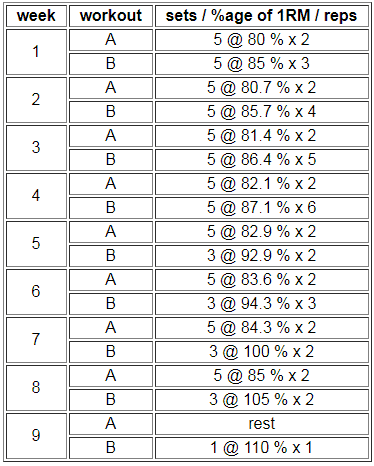
The structure splits cleanly at week 5. Weeks 1 to 4 build the B workout by adding a rep a week at roughly the same load, taking you from 15 reps to 30 reps in a session. Week 5 cuts that volume hard, from 5 sets of 6 down to 3 sets of 2, and starts pushing the percentage instead. From there the load climbs and the reps stay low.
Fred Hatfield Peaking Program FAQs
What max do I enter?
Your current 1RM, not a goal max. Weeks 7 through 9 prescribe 100%, 105% and 110% on purpose, and the whole program is built on the assumption that your actual strength is rising underneath those numbers. Entering a goal max puts the last three weeks out of reach.
Is there a deload?
Not a true deload week, though volume drops sharply at week 5 when the B workout goes from 5 sets of 6 to 3 sets of 2. Weekly tonnage falls a long way even as the percentage climbs, which is what lets the heavy work in weeks 7 to 9 feel manageable.
Can I run this for all three lifts at once?
Yes, and the spreadsheet is set up for it. Watch your recovery, though. Six sessions a week of near-max work in the back half is a lot, and running it on one lift while holding the other two steady is the safer choice if you are unsure.
What if I miss the 110% single?
A 10% jump in 9 weeks is ambitious for anyone past their first year or two of training. Missing it is common and does not mean the block failed. Take whatever you did hit as your new max and run the program again from there, or move to a different block and come back to it.
Fred Hatfield Peaking Program Spreadsheet
The spreadsheet supports both lb and kg rounding. It is said this program is heavily influenced by the 1976 squat routine, which in turn inspired the Russian Squat Routine and the Extended Russian Powerlifting Routine.

Related Peaking Programs
- Fred Hatfield 12 Week Peaking Program, the longer version of the same idea
- Russian Squat Routine
- Extended Russian Powerlifting Routine
Updates
- Converted the post to the block editor and added the full rep scheme as a readable table, which had previously existed only inside an image. Corrected the spreadsheet embed title, which was displaying a stale .xls filename, and pointed the Russian Squat Routine link at its current URL.
- KG and LB rounding are supported in the spreadsheet.
