
The RTS General Intermediate Program is a free 9-week powerlifting program from Mike Tuchscherer and Reactive Training Systems (RTS), the coaches behind some of the strongest raw lifters in the sport. It runs four training days a week early on and drops to three days later in the cycle. Every session pairs a competition-style main lift with variations and accessories, and each lift is prescribed as a number of reps at a target RPE rather than a fixed percentage of your max.
The whole thing is autoregulated. Instead of grinding a fixed percentage on a bad day, you work up to a top set at the prescribed reps and RPE, then use RTS fatigue percents to add your working volume. You drop the bar by a set percentage and keep doing sets until the RPE climbs to target. It’s the same idea RTS built its reputation on, and it’s a different animal from a straight percentage block like GZCLP.
This is a loose template, not a polished beginner program. It’s built for intermediate lifters who already rate RPE well and understand fatigue percents. If you’re still learning to gauge RPE or you want something more scripted, run a percentage-based program first and come back to this one. For a similar 9-week RPE-driven peak that’s laid out a bit more cleanly, see the TSA 9 Week Intermediate Program.
Table of Contents
RTS General Intermediate Program Spreadsheet
Enter your current 1RM for each lift in the yellow cells on the Inputs tab and the sheet builds every load for you. It reads the RTS RPE chart to turn each reps-at-RPE prescription into a top set, ramps three working sets up to it, and calculates the fatigue-percent drop weight for your backoff work. All 9 weeks are laid out session by session, with green cells to log what you actually hit and an expected-volume column to track against the weekly volume goals.

Program outline via /u/MagnesiumCarbonate, who first assembled the community spreadsheet this is based on.
About RTS and RPE
RTS has been one of the strongest proponents of using RPE, or Rate of Perceived Exertion, in training. If you’re not familiar with RPE, take the time to go over RTS’s own explanation of how to use RPE correctly before you start.
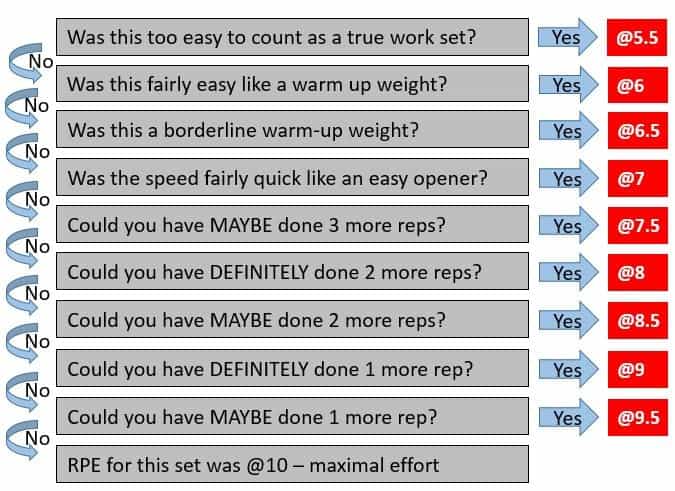
Here’s a visual summary of how RPE maps to reps in reserve:
About the RTS General Intermediate Program
This program is based on a loose template Mike Tuchscherer posted for a generalized intermediate lifter. To run it well you need to understand how the program is structured and how RTS uses fatigue percents. Without that, the spreadsheet goes from confusing to very confusing fast. Mike is a sharp coach, so it’s worth reading his material to understand how the method works before you decide whether to follow it.
The template was written for one hypothetical lifter, and the further you are from that profile, the less it fits you. He’s 30 years old, weighs 215 pounds, and has trained for about four years, posting Class 3 numbers on the Russian Classification Chart. He came up through 5×5 work and a short run of 5/3/1, and he’s moving from a 3-day template to a 4-day one. He’s read enough on the RTS site to be comfortable with RPE and fatigue percents. He’s healthy, has no time restrictions, trains with basic equipment, and lifts raw with no knee wraps. He deadlifts conventional, and his sticking points sit at the bottom of the lift.
Each training day gives you a main lift plus a couple of variations or accessories, all prescribed as reps at an RPE. Weeks 1 through 5 run four days, then the cycle tightens to three days for weeks 6 through 9. The reps and RPEs get heavier as you go, and week 9 peaks into heavy singles so you finish the block with openers and a top single on each lift.
RTS General Intermediate Program FAQs
What is the RTS General Intermediate Program?
It’s a free 9-week powerlifting program based on a generalized intermediate template from Mike Tuchscherer of Reactive Training Systems. It trains four days a week early in the cycle and drops to three days later, with every lift prescribed as reps at a target RPE and backoff volume driven by fatigue percents. Week 9 peaks into heavy singles.
Who should run the RTS Generalized Intermediate template?
Intermediate lifters who are comfortable rating RPE and already understand fatigue percents. The template was written around a Class 3 lifter with a few years of training under the bar. If you’re newer to structured training or you can’t gauge RPE reliably yet, build a base on a program like GZCLP first, then come back to this one.
How does RPE-based training differ from a percentage program?
A percentage program tells you to lift an exact number, like 80% of your max, no matter how you feel that day. RPE-based training gives you a target effort instead. An RPE 9 means you stop with about one rep left in the tank, an RPE 8 means about two. You pick the weight that hits that effort for the prescribed reps, so the load flexes up or down with how strong you are on the day. The spreadsheet still gives you a calculated starting weight from your 1RM, so you’re not guessing from scratch.
What are fatigue percents?
Fatigue percents are how RTS prescribes your backoff volume. After you hit the top set for the day, you drop the bar by a programmed percentage and keep doing sets of the same reps until your RPE climbs to the target. Some days use a repeat method instead, where you hold the weight and add sets, or a rep drop, where you keep the load and do fewer reps per set. The spreadsheet calculates the fatigue-drop weight for each lift so you know exactly where to start.
How long is the program?
Nine weeks. The early weeks run four training days at moderate RPEs to build volume, the middle weeks push the intensity up, and week 9 peaks into heavy singles so you can test or open a meet. The spreadsheet lays out all nine weeks session by session, so you can take it into the gym and just read off the day.
Can I substitute exercises in the RTS spreadsheet?
Yes. Enter a 1RM for any lift you want to swap in on the Inputs tab and the sheet will calculate its loads the same way. The variations in the template (paused benches, tempo squats, snatch-grip deadlifts, and the rest) are there to work specific positions, so if you replace one, pick a substitute that trains the same weak point. If you swap in a lift the sheet doesn’t have a max for, its load cells stay blank until you add one.
