The concentration curl is a seated, single-arm dumbbell exercise where you brace the back of your working elbow against the inside of your thigh and curl the weight up with nothing else moving. That braced position removes your shoulders and your torso from the lift entirely, so your biceps take the full load, and it’s one of the best exercises there is for building a hard peak contraction at the top of the rep. Most lifters run it for 2 to 3 sets of 10 to 15 reps per arm, usually toward the end of an arm day once the heavier compound pulling is done. Bodybuilders lean on it specifically because the strict setup makes it easy to feel exactly which part of the biceps is doing the work, which is harder to judge on a standing curl where your shoulders and hips can take over.
You might still want a substitute. Leaning forward with your elbow braced on your thigh can bother your lower back once the sets add up, and training one arm at a time doubles how long the exercise takes compared to a lift you can do with both arms together. Not every gym has open bench space, and if you train at home you might only have a cable setup or a curl machine. Or your biceps have just stopped responding to the same angle after months of running it the same way.
Here are the 8 concentration curl alternatives I’d reach for, ranked by how closely each one reproduces that braced, single-arm, peak-contraction loading. I picked these for how strictly they isolate the biceps and how safe they are on your elbows and lower back, with plenty of dumbbell and cable options plus one machine pick, so you can find something that fits your gym. I’ll tell you when to use each one and exactly how to do it.
Table of Contents
- 1 The 8 Best Concentration Curl Alternatives
- 2 Reasons to Choose a Concentration Curl Alternative
- 3 Muscles Worked by the Concentration Curl
- 4 FAQs
- 4.1 What’s the closest alternative to a concentration curl?
- 4.2 Can I build biceps peak without concentration curls?
- 4.3 What’s the best concentration curl alternative for a bad lower back?
- 4.4 What’s the best concentration curl alternative at home?
- 4.5 Why do concentration curls hurt my lower back?
- 4.6 How many bicep exercises should I do per workout?
- 5 Key Takeaways
- 6 Other Alternative Exercises
- 6.1 The 10 Best Bench Press Alternatives
- 6.2 The 8 Best Decline Bench Press Alternatives
- 6.3 The 9 Best Lunge Alternatives
- 6.4 The 9 Best Leg Press Alternatives
- 6.5 The 10 Best Bulgarian Split Squat Alternatives
- 6.6 The 9 Best T-Bar Row Alternatives
- 6.7 The 8 Best Ab Rollout Alternatives
- 6.8 The 10 Best Leg Extension Alternatives
- 6.9 The 12 Best Pull-Up Alternatives
- 6.10 The 10 Best Lat Pulldown Alternatives
- 6.11 The 8 Best Tricep Dip Alternatives
- 6.12 The 10 Best Front Squat Alternatives
- 6.13 The 10 Best Bent Over Row Alternatives
- 6.14 The 8 Best Hammer Curl Alternatives
- 6.15 The 10 Best Box Jump Alternatives
The 8 Best Concentration Curl Alternatives
- Spider Curl
- Preacher Curl
- Bayesian Cable Curl
- High Cable Curl
- Single-Arm Cable Curl
- Machine Bicep Curl
- Incline Dumbbell Curl
- Seated Dumbbell Curl
1. Spider Curl
When to Perform Spider Curls
This is the closest swap I’ve got for a concentration curl. Bracing your chest against an incline bench does the same job as bracing your elbow on your thigh, and you still get a hard peak contraction at the top since your upper arms can’t drift. The difference is you’re loading both arms in the same set instead of alternating, which cuts your time under the bar in half. I usually run 3 sets of 10 to 12 reps here, either in the same slot a concentration curl would sit in or right after a heavier pulling exercise.
How to Perform Spider Curls
- Set an adjustable bench to roughly a 60 degree incline and lean your chest against the angled side.
- Hold an EZ bar or a pair of dumbbells and let your arms hang straight down toward the floor.
- Curl the weight up toward your shoulders, keeping your upper arms pinned against the bench the whole rep.
- Lower back down under control until your arms are fully extended.
Equipment: EZ bar or dumbbells, an adjustable bench.
This video from ScottHermanFitness shows how to perform the spider curl with an EZ bar.

Tips for Spider Curls
- Keep your elbows pinned against the bench the whole set. Letting them drift forward takes the strictness out of the exercise.
- Slow the lowering phase down, since the stretched bottom position is where spider curls earn their reputation.
- Start with lighter weight than your normal curl, the strict position exposes momentum you didn’t know you were using.
- A reverse preacher bench setup works the same way if your gym doesn’t have a steep incline bench free.
For a full look at how the concentration curl stacks up against the standard biceps curl, see our concentration curl vs bicep curl comparison.
2. Preacher Curl
When to Perform Preacher Curls
Use this when you want a two-armed alternative that still locks your upper arm in place the way a concentration curl does, just against a pad instead of your thigh. It’s one of the most common isolation lifts in any gym, and I’d program 3 sets of 8 to 12 reps, either as your main biceps lift for the day or right after a heavier row.
How to Perform Preacher Curls
- Sit at a preacher bench and rest the backs of your upper arms against the angled pad.
- Grip an EZ bar or a pair of dumbbells with an underhand grip, arms extended.
- Curl the weight up until your forearms are close to vertical, stopping short of jamming your elbows.
- Lower back down under control until your arms are fully extended over the pad.
Equipment: preacher bench, EZ bar or dumbbells.
This video from REP shows how to perform the preacher curl step by step.

Tips for Preacher Curls
- Stop the descent an inch or two before full lockout on heavier sets, that’s where your elbow tendon takes the most stress.
- Keep your upper arms glued to the pad for the entire set.
- Use a wider or narrower grip on the EZ bar to shift emphasis between the two heads of your biceps.
- Go a size lighter than a standing curl, the pad removes any help from momentum.
For a full breakdown of how these two isolation lifts compare, see our preacher curl vs concentration curl comparison.
3. Bayesian Cable Curl
When to Perform Bayesian Cable Curls
This is my pick when you want the deepest stretch on this list along with a hard peak contraction, since the cable keeps tension on your biceps even with your arm pulled behind your torso. It’s single arm, the same way a concentration curl is, so you get that full focus on one side before switching. Run it for 3 sets of 10 to 15 reps per arm.
How to Perform Bayesian Cable Curls
- Set a cable to the lowest pulley position and attach a single handle.
- Face away from the machine and take a small step forward, letting your working arm hang behind your torso with the cable pulling it back.
- Curl the handle up and forward toward your shoulder without letting your elbow drift ahead of your torso.
- Lower back down slowly until your arm is fully extended behind you.
Equipment: cable machine, low pulley, single handle.
This video from Live Lean TV Daily Exercises shows how to perform the standing, face-away, single-arm Bayesian cable curl.

Tips for Bayesian Cable Curls
- Keep your torso still. The pull should come only from your elbow, not from rowing your shoulder back.
- Let your shoulder relax back at the bottom to get the full stretch, rather than rounding forward to compensate.
- Use lighter weight than you’d expect, the stretched position is demanding even at low loads.
- Reset your stance between arms instead of leaning the same direction for both sides.
4. High Cable Curl
When to Perform High Cable Curls
This one’s for peak-focused work once you’ve already got a base of biceps size, since it leans on the top of the contraction more than the stretch. Setting up with two high pulleys lets you curl both arms at once into a double-biceps pose, chasing the same peak a concentration curl is known for, just on both sides together. I’d use 3 sets of 12 to 15 reps as a finisher.
How to Perform High Cable Curls
- Set two pulleys to their highest position and attach a handle to each.
- Stand in the middle of the machine and grab a handle in each hand, arms extended out to your sides at shoulder height.
- Curl both handles in toward your head, squeezing your biceps hard at the top.
- Extend back out under control to the starting position.
Equipment: dual cable machine, two handles.
This video from OriGym shows how to perform the high cable curl.

Tips for High Cable Curls
- Keep your upper arms roughly level with your shoulders throughout, even as the set gets hard.
- Squeeze and hold for a full second at the top of every rep.
- If your gym only has one high pulley free, do this one arm at a time instead of both together.
- Use lighter weight than you’d use on a standing curl, the arm position alone is demanding on your shoulders.
5. Single-Arm Cable Curl
When to Perform the Single-Arm Cable Curl
Use this as your everyday cable substitute when you’d rather not deal with the stretched-behind-the-body setup a Bayesian curl asks for, or when your gym’s low pulley is already taken by someone doing the exercise above. It keeps constant tension on your biceps through the whole rep, something a dumbbell can’t do, and it’s still one arm at a time like a concentration curl. I’d run 3 sets of 12 to 15 reps.
How to Perform the Single-Arm Cable Curl
- Set a cable to the low pulley position and attach a single handle.
- Stand facing the machine, take a step back, and hold the handle with your arm extended down at your side.
- Curl the handle up toward your shoulder, keeping your elbow pinned at your side.
- Lower back down slowly until your arm is fully extended.
Equipment: cable machine, low pulley, single handle.
This video from OriGym shows how to perform the standing single-arm cable curl.

Tips for the Single-Arm Cable Curl
- Keep your elbow locked against your side the whole set. Letting it drift forward turns this into a shoulder exercise.
- Stand at a slight angle to the machine if a straight-on stance puts the cable in an awkward line with your arm.
- Add a brief pause at the top of each rep for a harder squeeze.
- Match the cable height to roughly hip level so the resistance stays in line with your forearm through the whole range.
Want more cable-only options for your biceps? See our cable bicep exercises roundup.
6. Machine Bicep Curl
When to Perform the Machine Bicep Curl
This is the strictest option on the list, and that’s a compliment. The pad locks your upper arm in place so completely that you can’t cheat the weight up even late in a hard set, which makes it a good pick when your form breaks down on free weight curls before your biceps are actually fatigued. It’s also easy on your lower back since you’re seated and supported the whole time. I’d program 3 sets of 10 to 12 reps.
How to Perform the Machine Bicep Curl
- Sit at the machine and adjust the seat so your upper arms rest flat on the pad with your elbows lined up with the pivot point.
- Grip the handles with an underhand grip, arms extended.
- Curl the handles up until your forearms are close to vertical.
- Lower back down under control to a full stretch.
Equipment: bicep curl machine.
This video from ScottHermanFitness shows how to perform the Hammer Strength machine bicep curl.

Tips for the Machine Bicep Curl
- Adjust the seat height before you load the weight. A poorly fit machine puts stress on your elbows instead of your biceps.
- Start each rep under control, the fixed path means bad momentum has nowhere to go but your joints.
- Use the single-arm setting if your machine has one and your arms are uneven in strength.
- Pause briefly at the top of each rep, since the machine makes it easy to rush through the range.
7. Incline Dumbbell Curl
When to Perform Incline Dumbbell Curls
Pick this one when you want more stretch than a concentration curl gives you, since your arm hangs behind your torso for the entire set instead of just at the bottom. It trains both arms together while still isolating your biceps, and I’ll usually program it for 3 sets of 10 to 12 reps early in an arm session while I’m still fresh enough to control the stretch.
How to Perform Incline Dumbbell Curls
- Set an adjustable bench to a 45 to 60 degree incline and sit back against it with a dumbbell in each hand.
- Let your arms hang straight down from your shoulders.
- Curl the dumbbells up toward your shoulders without letting your elbows drift forward.
- Lower back down slowly until your arms are fully extended.
Equipment: adjustable bench, dumbbells.
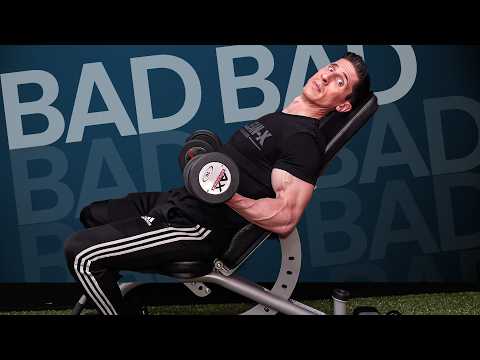
This video from ATHLEAN-X shows how to perform the incline dumbbell curl with correct form.
Tips for Incline Dumbbell Curls
- Keep your shoulder blades pinned to the bench so your shoulders don’t roll forward at the bottom.
- Slow the lowering phase down, that stretched position is the whole point of this exercise.
- A steeper incline increases the stretch, a shallower one makes it easier to load heavier.
- Curl one arm at a time instead of both together if one side is noticeably weaker.
8. Seated Dumbbell Curl
When to Perform Seated Dumbbell Curls
This is the simplest option on the list and the one I’d point a beginner toward first. All you need is a bench and a pair of dumbbells, and sitting down takes your legs and lower back out of the lift entirely, so it’s an easy way to learn what strict biceps tension actually feels like before moving to something more advanced. Run it for 3 sets of 10 to 12 reps per arm, alternating or both at once.
How to Perform Seated Dumbbell Curls
- Sit on a flat bench with a dumbbell in each hand, arms hanging at your sides.
- Keep your torso upright, bracing against the back of the bench if it has one.
- Curl one or both dumbbells up toward your shoulders, rotating your palms to face up as you go.
- Lower back down under control to full extension.
Equipment: flat bench, dumbbells.
This video from Horton Barbell shows how to perform seated dumbbell curls and covers the most common mistakes.

Tips for Seated Dumbbell Curls
- Alternate arms if you catch yourself swinging the weight up when curling both at once.
- Keep your elbows just in front of your torso rather than letting them drift back as the set gets hard.
- Rotate your wrist so your palm faces up by the halfway point of the rep for the strongest contraction.
- Sit close to the front edge of the bench so your knees don’t get in the way of the dumbbell path.
Reasons to Choose a Concentration Curl Alternative
There are a few good reasons to swap out the concentration curl for one of the options above. None of them are a downgrade. Each one keeps your biceps under strict tension, and a few let you train both arms in the same set instead of alternating. If you’re actually after a break from the neutral-grip pump of a hammer curl instead, check out our hammer curl alternatives guide.
- You don’t have a bench free. The high cable curl, single-arm cable curl, and machine bicep curl need a cable station or a curl machine, not a spot on the bench.
- Bending forward at the hip bothers your lower back. The preacher curl, machine bicep curl, and incline dumbbell curl all support your torso instead of asking you to brace against your thigh.
- You want to train both arms at once. Spider curls, preacher curls, high cable curls, and incline dumbbell curls all load two arms in the same set, so you’re not doubling your time under the bar.
- You want more stretch than a concentration curl gives you. The Bayesian cable curl and incline dumbbell curl both put your biceps under tension well behind your torso, deeper than a concentration curl’s dead-hang bottom position.
- Your biceps have stalled. A new angle like the high cable curl or Bayesian cable curl gives your arms a fresh stimulus after months on the same lift.
Muscles Worked by the Concentration Curl
Your biceps brachii has two heads that both cross the elbow, but only the long head also crosses the shoulder joint. A concentration curl’s braced, close-elbow position keeps tension mostly on the short head and the peak of the muscle, which is why lifters use it to bring up that rounded shape at the top of the arm. The alternatives above hit the same muscle group from angles that shift the emphasis toward the long head, the forearm, or both heads evenly, depending on how your arm is positioned during the rep. These are the muscles doing the work on a concentration curl and its substitutes.
- Biceps brachii, short head: the primary target on a concentration curl, loaded hardest by the close elbow position. Alternatives that keep your elbow tucked close to your torso, like the preacher curl and machine bicep curl, train it the same way.
- Biceps brachii, long head: works hardest on exercises that stretch your arm behind your torso, like the Bayesian cable curl and incline dumbbell curl.
- Brachialis: sits underneath the biceps and helps drive elbow flexion on every exercise on this list, especially on the machine bicep curl where the fixed path keeps it under constant load.
- Brachioradialis: a forearm muscle that assists on all of these, particularly on cable and machine variations where your grip stays fixed through a longer range.
- Wrist flexors: work isometrically to keep your grip locked on a dumbbell, bar, or handle, especially on heavier sets like the preacher curl or spider curl.
- Anterior deltoid: gets light secondary work on the incline dumbbell curl and high cable curl, since your shoulder helps position your arm before your biceps take over.
For more on training the biceps by head, see our guides to long head bicep exercises and short head bicep exercises.
FAQs
What’s the closest alternative to a concentration curl?
The spider curl. Bracing your chest against an incline bench does the same job as bracing your elbow on your thigh, and you still get a hard peak contraction at the top since your upper arms can’t drift. The preacher curl is a close second if you want an even deeper stretch at the bottom of the rep.
Can I build biceps peak without concentration curls?
Yes. Peak contraction comes from keeping your elbow fixed and squeezing hard at the top of the rep, and a dumbbell held braced against your thigh isn’t the only way to do that. The spider curl and preacher curl lock your upper arm in place the same way, and the machine bicep curl does it too, just against a pad instead of a bench. Any of them will build the same rounded shape over time.
What’s the best concentration curl alternative for a bad lower back?
The preacher curl, machine bicep curl, or incline dumbbell curl. All three support your torso against a pad or a bench, so you’re not hinged forward at the hip the way a concentration curl asks you to be. If your back is still touchy, the seated dumbbell curl keeps you upright with the least equipment of the bunch.
What’s the best concentration curl alternative at home?
The incline dumbbell curl or seated dumbbell curl, since a bench and a pair of dumbbells cover both. Resistance bands anchored under your foot work in a pinch too, using the same braced, close-elbow setup a concentration curl uses.
Why do concentration curls hurt my lower back?
Usually it’s the forward hip hinge you hold for the entire set, which puts a steady, fatiguing load on your lower back muscles while they’re already working to keep you upright. If that’s an issue, switch to a supported option like the preacher curl or machine bicep curl, or shorten your sets and take a longer rest between arms so you’re not holding the hinge as long.
How many bicep exercises should I do per workout?
One is usually enough on a day where you’re also pulling, since your biceps already get worked by rows or pull-ups before you isolate them further. On a dedicated arm day, 2 to 3 exercises covering different angles, a stretched position like the Bayesian cable curl and a strict peak-focused lift like the preacher curl, will cover the muscle well without piling on junk volume. Adding a fifth or sixth curl variation past that point usually just adds fatigue without adding much new stimulus, since you’ve already trained the biceps through their full range.
Key Takeaways
If you want the closest peak-contraction swap, go with the spider curl or preacher curl. Both lock your elbow in place the same way a concentration curl does, and both let you train two arms at once. If your lower back is the reason you’re looking for a substitute, the preacher curl and machine bicep curl support your torso against a pad, and the incline dumbbell curl does the same job with a bench. Training with nothing but a cable station, the Bayesian cable curl gives you the deepest stretch on this list, and it’s still single arm, so it trains exactly the way a concentration curl does. Pick based on what’s actually bothering you about the concentration curl, whether that’s your elbow, your lower back, or just wanting a change, and progress it the same way you’d progress a concentration curl, more weight or more reps over time. Two or three of these that match your equipment and what’s bothering you will do more for your biceps than trying to cram every option into one program.
Other Alternative Exercises
If you enjoyed this post, check out our other roundups of the best alternatives for other exercises.