The spider curl is a strict biceps isolation exercise where you lie face down on a steep incline bench with your chest pressed into the pad and your arms hanging straight down, perpendicular to the floor. Holding an EZ bar or a pair of dumbbells, you curl the weight up toward your face and lower it back under control. Because your torso is locked flat against the bench, you can’t swing your hips or lean back to help the weight up, so every rep comes from your biceps alone. That strict position, combined with your arms hanging slightly in front of your body instead of at your sides, puts extra emphasis on the short head and gives you a hard peak contraction at the top of each rep.
You might want a substitute for a few reasons. Not every gym has a steep enough preacher bench set up for the face-down position, since plenty of preacher benches are built for the seated, arms-on-pad version instead. Getting into position can be awkward too, especially if you’re tall and your chest and hips don’t line up well on the pad. Or maybe your biceps have plateaued on spider curls and you want a different angle to keep growing.
Here are the 8 spider curl alternatives I reach for most, picked for how strictly they isolate the biceps, how close they get to that same peak contraction, and what equipment they need. Some of these are close swaps you could run in the exact same slot as a spider curl, and others trade a little strictness for more weight on the bar. A couple hit the biceps from a completely different angle, which is worth having in your back pocket once your progress on spider curls slows down. I’ll tell you when to use each one and exactly how to do it.
Table of Contents
- 1 The 8 Best Spider Curl Alternatives
- 2 Reasons to Choose the Spider Curl
- 3 Muscles Worked by the Spider Curl
- 4 FAQs
- 4.1 What’s the closest alternative to a spider curl?
- 4.2 Can I build a bicep peak without spider curls?
- 4.3 What’s the best spider curl alternative if I don’t have a preacher bench?
- 4.4 Is the spider curl better than a standard bicep curl?
- 4.5 What if I want brachialis size instead of a bicep peak?
- 4.6 How many bicep exercises should I do per workout?
- 5 Key Takeaways
- 6 Other Alternative Exercises
- 6.1 The 7 Best Deadlift Alternatives
- 6.2 The 10 Best Plank Alternatives
- 6.3 The 10 Best Romanian Deadlift Alternatives
- 6.4 The 12 Best Pull-Up Alternatives
- 6.5 The 9 Best Seated Cable Row Alternatives (2026)
- 6.6 The 10 Best Pallof Press Alternatives
- 6.7 The 9 Best Pendlay Row Alternatives
- 6.8 The 10 Best Hack Squat Alternatives
- 6.9 The 9 Best Lunge Alternatives
- 6.10 The 10 Best Dumbbell Pullover Alternatives
- 6.11 The 10 Best Bulgarian Split Squat Alternatives
- 6.12 The 9 Best Leg Press Alternatives
- 6.13 The 10 Best Front Squat Alternatives
- 6.14 The 10 Best Overhead Press Alternatives
- 6.15 The 9 Best T-Bar Row Alternatives
The 8 Best Spider Curl Alternatives
- Preacher Curl
- Concentration Curl
- Incline Dumbbell Curl
- Cable Curl
- Bayesian Cable Curl
- High Cable Curl
- Seated Dumbbell Curl
- Machine Bicep Curl
1. Preacher Curl
When to Perform the Preacher Curl
This is the closest swap I’ve got for a spider curl. Your upper arm is braced against a pad through the whole set, so you lose almost the same amount of cheating room a spider curl takes away, and nearly every gym has a preacher bench. Use it when your gym doesn’t have a bench steep enough for the face-down spider curl setup, or when you just want a more comfortable way to get the same strict isolation. I usually program it for 3 sets of 8 to 12 reps, in the same slot a spider curl would sit in.
How to Perform the Preacher Curl
- Sit at a preacher bench and rest the backs of your upper arms flat against the angled pad.
- Grip an EZ bar with your hands shoulder-width apart, palms facing up.
- Lower the bar until your arms are almost fully straight, without letting your upper arms lift off the pad.
- Curl the bar back up toward your shoulders, squeezing your biceps hard at the top.
Equipment: preacher bench and an EZ bar (a straight bar or dumbbells work too).
This video from REP shows how to perform the preacher curl.

Tips for the Preacher Curl
- Don’t lock your elbows out hard at the bottom. Stop a couple of inches short to keep tension on your biceps and off the joint.
- Keep your upper arms glued to the pad the entire set, even on the last hard reps.
- Go lighter than your regular curl weight, since the pad removes any momentum you’d normally get from your shoulders.
- An EZ bar is easier on your wrists than a straight bar in this position.
For a full breakdown of how this compares to another close-cousin isolation curl, see our preacher curl vs concentration curl comparison.
2. Concentration Curl
When to Perform the Concentration Curl
Reach for this when you want peak contraction without needing any bench at all, or when you’re training one arm at a time to fix a size imbalance. Bracing your elbow against your inner thigh does the same job a preacher pad or spider curl bench does, it locks your upper arm still so the rep comes entirely from your biceps. I run this for 3 sets of 10 to 12 reps per arm, usually toward the end of an arm day once my biceps are already warmed up.
How to Perform the Concentration Curl
- Sit on a bench with your legs spread and a dumbbell in one hand.
- Lean forward and brace the back of your upper arm against the inside of your thigh.
- Lower the dumbbell until your arm is fully straight.
- Curl the dumbbell up toward your shoulder, keeping your upper arm pinned against your thigh, then lower it back under control.
Equipment: one dumbbell and a flat bench.
This video from Howcast shows how to perform the concentration curl.

Tips for the Concentration Curl
- Keep your torso still. Rocking your shoulders forward turns this into a swing instead of a curl.
- Squeeze and hold for a full second at the top of each rep before lowering.
- Use a slightly lighter weight than a standing curl, since your body position gives you no help from momentum.
- Turn your wrist slightly as you curl up, rotating your pinky toward your shoulder, for a harder peak squeeze.
See our concentration curl vs bicep curl comparison for more on how this stacks up against a standard curl.
3. Incline Dumbbell Curl
When to Perform the Incline Dumbbell Curl
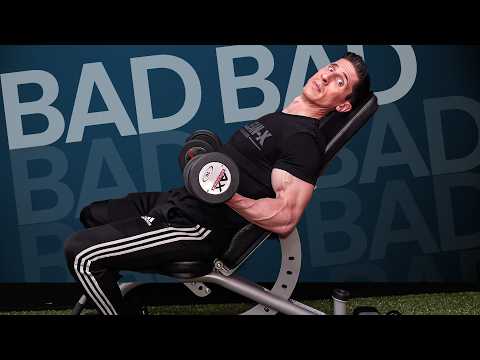
This is the pick when you want a deep stretch on your biceps instead of a peak squeeze. Sitting back on an incline bench pins your shoulders behind your torso, so your arms hang straight down and slightly behind your body at the bottom of each rep, stretching your long head hard. It won’t lock your upper arms in place the way a spider curl does, so you’ll need to actively keep your elbows still yourself. I program this for 3 sets of 10 to 12 reps, usually early in a session while I’ve still got the discipline to keep strict form.
How to Perform the Incline Dumbbell Curl
- Set a bench to a 45 to 60 degree incline and sit back with your shoulders and head against the pad.
- Let a dumbbell hang straight down in each hand, palms facing forward.
- Curl both dumbbells up toward your shoulders without letting your elbows drift forward.
- Lower them back down under control until your arms are fully straight.
Equipment: incline bench and a pair of dumbbells.
This video from ATHLEAN-X shows how to perform the incline dumbbell curl with proper form.
Tips for the Incline Dumbbell Curl
- Keep your shoulders pinned to the pad. If they round forward at the top, you’re cheating the rep.
- Go lighter than a standing dumbbell curl. The stretched starting position makes the first few inches of the rep much harder.
- Curl both arms together or alternate, whichever lets you keep stricter form.
- Stop the lowering phase just before your arm is bone-on-bone straight to keep tension on your biceps.
4. Cable Curl
When to Perform the Cable Curl
Use this when you want the constant tension a cable gives you, since a dumbbell or bar loses resistance right at the top of a curl but a cable doesn’t. It’s a good finisher after a heavier isolation exercise, or a way to keep tension on your biceps for a burnout set. I usually run 3 sets of 12 to 15 reps here, since the steady resistance makes it work well at higher reps than a spider curl.
How to Perform the Cable Curl
- Attach a straight bar or EZ bar to a low pulley and stand a step back from the stack.
- Grip the bar with your palms facing up and your elbows at your sides.
- Curl the bar up toward your shoulders, keeping your upper arms still.
- Lower the bar back down under control until your arms are fully straight.
Equipment: cable machine, low pulley, straight or EZ bar attachment.
This video from Men’s Health Muscle shows how to perform the cable biceps curl with proper form.

Tips for the Cable Curl
- Keep your elbows locked at your sides through the whole set. Letting them swing forward turns it into a shoulder exercise.
- Stand far enough back that the cable stays in a straight line up to the pulley.
- Squeeze at the top for a full second before lowering.
- Switch to a rope or single-handle attachment every few weeks to change your grip angle.
For more cable-only bicep options, see our cable bicep exercises roundup.
5. Bayesian Cable Curl
When to Perform the Bayesian Cable Curl
This is my pick when I want that same forward-hanging arm angle a spider curl gives you, but standing instead of face down on a bench. Facing away from a low pulley puts your arm behind your torso at the bottom of the rep, stretching your biceps hard and biasing the short head, similar to how a spider curl loads it. I’ll program this for 3 sets of 10 to 12 reps per arm, usually as a dedicated peak-and-stretch exercise on an arm day.
How to Perform the Bayesian Cable Curl
- Set a cable to a low pulley and attach a single handle.
- Face away from the machine and step forward until your arm is stretched slightly behind your torso.
- Curl the handle up toward your shoulder, keeping your upper arm still.
- Lower it back down under control, letting your arm stretch behind you again at the bottom.
Equipment: cable machine, low pulley, single handle attachment.
This video from Chris Gates Fitness shows how to perform the Bayesian cable curl.

Tips for the Bayesian Cable Curl
- Don’t let your elbow drift forward as you curl. It should stay roughly behind your torso the whole rep.
- Start with a lighter weight than you’d expect. The stretched starting position is deceptively hard.
- Keep a slight forward lean from the hips instead of standing bolt upright, to keep the cable path lined up with your arm.
- Train one arm at a time so you can focus on keeping your elbow still.
6. High Cable Curl
When to Perform the High Cable Curl
Use this one when you want to hit your biceps peak from a different angle than anything else on this list. With your arms out to the sides instead of hanging down, the top of the rep gets an intense squeeze that’s hard to replicate any other way. It’s demanding on your shoulders too, so I treat it as a finisher rather than a main exercise, for 2 to 3 sets of 12 to 15 reps once your shoulders are already warmed up from earlier sets.
How to Perform the High Cable Curl
- Set two cable pulleys to the highest position and attach a handle to each.
- Grab a handle in each hand and step out to the middle, so your arms are stretched out to your sides at shoulder height.
- Curl both handles in toward your head, keeping your upper arms level and still.
- Extend your arms back out to the sides under control.
Equipment: cable machine with two adjustable pulleys, two handle attachments.
This video from HASfit shows how to perform the high cable curl.

Tips for the High Cable Curl
- Keep your upper arms roughly level with your shoulders the whole set. Letting them drop turns it into a different exercise.
- Use light weight. Most people can only handle a fraction of what they’d curl on a standard cable curl.
- Squeeze hard as the handles reach your head, that’s the whole point of this variation.
- Keep your elbows slightly bent rather than locked straight at the bottom to protect your elbow joints.
7. Seated Dumbbell Curl
When to Perform the Seated Dumbbell Curl
This is your option when you want to strip out the momentum a standing curl allows without needing an incline bench, a preacher pad, or a cable stack. Sitting down takes your legs and hips out of the movement, so you’re left leaning on strict elbow flexion, closer to a spider curl than a standing curl gets you. I run this for 3 sets of 10 to 12 reps, usually as my main curl on days I don’t have access to a preacher bench or a cable machine.
How to Perform the Seated Dumbbell Curl
- Sit on a bench with a dumbbell in each hand, arms hanging at your sides.
- Keep your back straight and your upper arms pinned to your torso.
- Curl both dumbbells up toward your shoulders, or alternate one arm at a time.
- Lower them back down under control until your arms are fully straight.
Equipment: a bench and a pair of dumbbells.
This video from Horton Barbell shows how to perform seated dumbbell curls.

Tips for the Seated Dumbbell Curl
- Sit tall against the bench back, don’t let your torso lean back to help the weight up.
- Keep your elbows pinned to your sides through the whole set.
- Rotate your palms fully upward as you curl for a harder peak contraction.
- Alternate arms if you find you’re cheating one side more than the other with both dumbbells at once.
8. Machine Bicep Curl
When to Perform the Machine Bicep Curl
This is the option for anyone who wants a spider curl’s strict isolation without having to balance anything themselves. The machine’s fixed path and padded seat brace your body for you, so you can push closer to failure without your form breaking down. I use this for 3 sets of 10 to 15 reps, usually as a last exercise on an arm day when I want to grind out a hard final set safely.
How to Perform the Machine Bicep Curl
- Sit at the machine and adjust the seat so your elbows line up with the pivot point.
- Rest the backs of your upper arms on the pad and grip the handles.
- Curl the handles up toward your shoulders, keeping your upper arms on the pad.
- Lower back down under control until your arms are fully straight.
Equipment: a bicep curl machine.
This video from Live Lean TV Daily Exercises shows how to perform the machine seated biceps curl.

Tips for the Machine Bicep Curl
- Adjust the seat height every time you use a new machine, since the pivot point varies between brands.
- Keep your upper arms flat on the pad the whole set, even as your grip starts to fade.
- Use the machine’s fixed path to push your last set closer to failure than you’d safely go with free weights.
- Slow the lowering phase down instead of just letting the stack drop.
Reasons to Choose the Spider Curl
After a list like that, it’s worth saying plainly that the spider curl earns its spot. It’s still the strictest bicep isolation exercise you can do without a machine holding you in place. Your torso is physically pinned to the bench, so there’s no leaning back, no hip drive, and no way to cheat the last couple of reps. If your goal is a hard peak contraction and short head development, and your gym has a bench steep enough for the setup, I’d default to the spider curl over any alternative on this list.
I’d still swap it out on days it doesn’t make sense, though. If your gym’s preacher bench doesn’t go steep enough to lie face down on, or the pad digs into your ribs before you can even get your arms hanging straight, forcing the position isn’t worth it. That’s when I’d grab a preacher curl or a Bayesian cable curl instead and get most of the same benefit without fighting the equipment.
- You want the strictest possible curl. Nothing else here removes body English as completely as your chest pinned flat against a steep bench.
- You’re chasing a bicep peak. The forward-hanging arm angle biases the short head harder than a standing or seated curl does.
- You’ve plateaued on preacher curls. The angle is close enough to feel familiar but different enough to give your biceps a new stimulus.
- You want a repeatable exercise for tracking progress. The locked position makes it easy to compare weight and reps week to week without form drift skewing the numbers.
Muscles Worked by the Spider Curl
Your biceps brachii has two heads, and the spider curl’s forward-hanging arm position loads them a little differently than a standing curl does. Because your torso is pinned to the bench and your arms hang slightly in front of your shoulders instead of straight down at your sides, the short head takes on more of the work than it would in a standard curl. That’s the whole reason lifters chasing a rounder, higher bicep peak gravitate toward the spider curl and its closest alternatives instead of a plain standing curl. The exercise and its alternatives train these muscles almost on their own:
- Biceps brachii, short head: the primary target on the spider curl and the Bayesian cable curl, both of which put your arm in that forward, slightly stretched position that biases this head over the long head.
- Biceps brachii, long head: works hardest on exercises where your arm hangs straight down or slightly behind your torso, like the incline dumbbell curl, and it’s what gives your arm its outer bulk.
- Brachialis: sits underneath the biceps and helps drive elbow flexion on every exercise on this list, though it’s most active on curls done with a neutral or hammer grip.
- Brachioradialis: a forearm muscle that assists with elbow flexion, especially on heavier curls like the seated dumbbell curl and machine curl where grip strength becomes a limiting factor.
- Wrist flexors: work isometrically to keep your grip on the bar, dumbbell, or handle stable through every rep, most noticeably on the cable variations.
For more on training the biceps by head, see our guides to long head bicep exercises and short head bicep exercises.
FAQs
What’s the closest alternative to a spider curl?
The preacher curl. Both exercises brace your upper arm against a pad so your torso can’t help the weight up, and both give you a hard peak contraction at the top. If your gym only has a preacher bench and not one steep enough for a face-down spider curl setup, the preacher curl is the swap to make.
Can I build a bicep peak without spider curls?
Yes. The Bayesian cable curl and concentration curl both put your arm in a similar forward or fixed position and give a similarly hard squeeze at the top. Your biceps respond to loaded, controlled tension through a full range, and they don’t care which exercise gets them there as long as you progress the weight or reps over time.
What’s the best spider curl alternative if I don’t have a preacher bench?
The concentration curl or the seated dumbbell curl. Both need nothing more than a flat bench and a set of dumbbells, and both strip out most of the momentum a standing curl allows. The concentration curl gets you closer to that strict peak contraction, while the seated dumbbell curl lets you move a bit more weight.
Is the spider curl better than a standard bicep curl?
Not better, just different. A standing bicep curl lets you move more weight and works your biceps as part of a bigger kinetic chain, while the spider curl isolates them more strictly and puts more emphasis on the short head. I’d use both across a training week rather than picking one over the other permanently. Run a heavier standing or seated curl early in your session for size, then finish with a spider curl or one of its alternatives to chase the peak.
What if I want brachialis size instead of a bicep peak?
None of the exercises on this list target the brachialis directly, since they’re all built around a palms-up grip that puts most of the tension on your biceps. If brachialis size is the goal, switch to a neutral or hammer grip instead. Our hammer curl alternatives guide covers that ground.
How many bicep exercises should I do per workout?
One or two is plenty on a day where you’re also pulling or rowing, since your biceps already get worked as a secondary mover on those lifts. On a dedicated arm day, 2 to 3 bicep exercises covering different angles, like a stretched position, a peak-contraction position, and a heavier compound-style curl, will cover the muscle well without piling on junk volume.
Key Takeaways
If you want the closest match to a spider curl’s strict isolation, go with the preacher curl. If your gym doesn’t have a preacher bench either, the concentration curl gets you nearly the same peak squeeze with nothing but a dumbbell and a flat bench. For that same forward-hanging stretch a spider curl gives you but standing up, the Bayesian cable curl is the one to try. And if you just want to push a final set closer to failure without worrying about your form breaking down, the machine bicep curl will do that safely. Pick based on what equipment you’ve got and how strict you need the movement to be, then progress it the same way you’d progress a spider curl: more weight or more reps over time, not more momentum.
Other Alternative Exercises
If you enjoyed this post, check out our other roundups of the best alternatives for other exercises.