
PHAT (Power Hypertrophy Adaptive Training) is a 5-day powerbuilding program created by Dr. Layne Norton. It splits the week into two power days and three hypertrophy days, with each session built around a major compound movement.
The program blends heavy low-rep power work with higher-rep hypertrophy work. It’s a good fit for bodybuilders who want to add real strength to their size work, or lifters who want to look athletic and actually be strong.
PHAT is best for intermediate lifters who can commit to five days per week and recover from that kind of volume. If you’re newer to lifting, you’ll make faster progress on a simpler program like the Candito Linear Program before tackling PHAT’s demands.
Table of Contents
PHAT on Boostcamp App
If you prefer to use a free app version, Boostcamp is a good option.

Prefer an app to a spreadsheet? If so, you're in luck!
Boostcamp has a free app version of the PHAT Program that you can use directly from your phone.
It tracks your progress and calculates your lifts, just like a spreadsheet.
Works on iOS and Android.
PHAT Workout Program Spreadsheet
PHAT Program by Dr. Layne Norton (Biolayne)
 PHAT Workout Log | LiftVault.com
PHAT Program Overview
PHAT Workout Program Summary
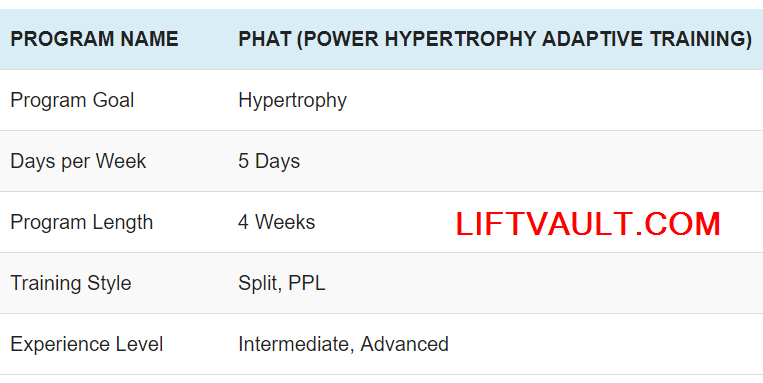
| Program Name | PHAT (Power Hypertrophy Adaptive Training) |
|---|---|
| Program Goal | Hypertrophy |
| Days per Week | 5 Days |
| Program Length | 4 Weeks |
| Training Style | Split, PPL |
| Experience Level | Intermediate, Advanced |
Each PHAT training session is centered around a major compound movement (squat, bench press, deadlift, dumbbell press). A training week has 5 sessions: 2 power sessions and 3 hypertrophy sessions.
PHAT Routine Schedule
- Day 1: Upper Body Power Training
- Day 2: Lower Body Power Training
- Day 3: Rest
- Day 4: Back & Shoulders Hypertrophy Training
- Day 5: Lower Body Hypertrophy Training
- Day 6: Chest & Arms Hypertrophy Training
- Day 7: Rest
Power training days call for 3 sets of 3-5 reps. The spreadsheet runs a 4-week %1RM wave across power days at roughly 70/72.5/77.5/80%, so you’re not just picking a weight and staying there. Norton’s original PHAT prescribes rep targets and progressive overload, not a fixed percentage wave. The 70 to 80% structure here matches the version in Norton’s own Boostcamp app (a 4-week block you restart after a deload), so treat the wave as a loading convention layered on PHAT rather than a literal Norton prescription.
Each hypertrophy training day will repeat the primary movement of that week’s power day. For example, the lower hypertrophy day calls for squats, just like the lower power day. The primary difference is that the weight will be lower, 70% of what was squatted earlier in the week, for 6 sets of 3. These should be speed movements, as the weight is light. Rest between sets should be limited to 1-2 minutes. When starting out, stop at 1 to 2 reps short of failure, or else you will very likely burn out and not be able to recover between training sessions.
As this is plenty of accessory volume, weights should be kept light as the body adjusts. Layne recommends deloading every 6 to 12 weeks, with the deload lasting for 1 to 3 weeks at 60-70% of normal weights.
PHAT Program by Dr. Layne Norton (Biolayne)
PHAT Frequently Asked Questions (FAQs)
What is PHAT?
PHAT stands for Power Hypertrophy Adaptive Training. It’s a strength and hypertrophy program developed by Dr. Layne Norton for athletes looking to build both size and power. It runs two power days and three hypertrophy days each week, with each day centered on a major compound movement.
The power days use heavy loading with low reps. The hypertrophy days repeat the same movements at lower intensity and higher volume. The combination is meant to drive both strength and muscle growth at the same time.
How long is the PHAT program?
PHAT is structured as a repeatable 4-week wave. Each wave runs power days at roughly 70/72.5/77.5/80% of your 1RM. When the wave ends, you retest your maxes and run it again at the new numbers.
Most people run it for roughly 8 to 12 weeks before taking a full deload and reassessing. Layne recommends deloading every 6 to 12 weeks, dropping to 60-70% of normal weights for 1 to 3 weeks. Because you’re retesting and repeating, the program can keep working as long as you keep adding weight to the bar.
Who should run PHAT?
Anyone looking to build strength and muscle mass can try PHAT, but due to the high volume, high intensity, and exercise variety, it’s hard to recommend this program for beginners. Plus, beginners would make faster progress on a linear progression program like the Candito Linear Program.
Deloading every third week is a waste of time for beginner strength athletes (Permanent Disclaimer About Deloads on Any Program: assuming the athlete is still making gains and is not feeling rundown). For pure aesthetic goals, this is a fine program to run as soon as you’re comfortable with the exercises.
Is PHAT good for cutting?
You can run PHAT in a calorie deficit, but recovery becomes harder. Five days per week at this volume is already demanding in a surplus. In a deficit, you’ll need to be more careful about sleep, protein intake, and not pushing too close to failure on the hypertrophy days.
If you’re cutting aggressively, a lower-frequency program might be a better fit until you’re back at maintenance.
How do I add deadlifts to PHAT?
Deadlifts aren’t prescribed in the default PHAT schedule, but Layne Norton recommends adding them to Lower Body Power Day. You’d put them in as the primary or secondary compound on Day 2, before or after your squat work depending on which lift you want to prioritize.
Keep the loading and rep scheme consistent with the rest of the power day (3 sets of 3-5 reps, following the 4-week wave). Don’t add deadlifts on a hypertrophy day without reducing volume elsewhere, or fatigue will stack up fast.
Updates
- October 28, 2019: Fixed the squat calculation in the spreadsheet thanks to a user that reported an issue using the contact form.
